Executive Summary
Urban flooding is emerging as a material economic risk for Nigeria, with consequences for commercial property, transport networks, industrial operations, household wealth and public finances. The World Bank estimates that the 2022 floods caused approximately $6.7 billion in economic losses nationally, equivalent to 1.6% of gross domestic product. Although this figure covers a nationwide disaster rather than Lagos alone, it demonstrates the scale of potential financial exposure.
Lagos provides a particularly important case study because its coastal geography, concentration of economic activity, rapid urbanisation and drainage constraints combine to create significant flood exposure. The introduction of a parametric flood insurance policy offering up to $7.5 million for emergency response and recovery, alongside substantial public expenditure on drainage infrastructure, illustrates the growing importance of financial protection and adaptation investment. However, the effectiveness of these interventions will depend on whether investment reduces underlying vulnerabilities rather than simply financing recovery after each disaster.
The broader economic challenge is to incorporate physical climate risk into property valuation, corporate planning, lending, insurance underwriting, and infrastructure development before flooding translates into recurring losses and declining asset performance.
1. Why It Matters: Flooding Is Becoming an Economic Risk
Flooding is often treated as an environmental or emergency-management problem. However, its economic consequences increasingly require attention from investors, financial institutions, property developers and businesses operating in vulnerable cities.
A flood event can damage buildings and machinery, interrupt transport, delay deliveries, destroy inventory and prevent employees from reaching workplaces. Even where commercial premises remain physically intact, disruptions to roads, electricity, water supply and logistics can affect revenue and operating costs.
The scale of Nigeria’s exposure is illustrated by the World Bank’s assessment of the 2022 floods. Using its Global Rapid Post-Disaster Damage Estimation (GRADE) methodology, the institution estimated total economic losses at $6.7 billion, equivalent to approximately 1.6% of national gross domestic product. More than 650,000 hectares of crops were destroyed, while damage affected roads, irrigation systems, water infrastructure, sanitation, and electricity. The estimated agricultural losses ranged from $526 million to $2.473 billion, depending on yield assumptions, the extent of damage and the feasibility of replanting. These are national estimates and should not be interpreted as losses attributable to urban flooding alone.
The economic significance extends beyond the immediate cost of replacing damaged assets. Repeated flooding can reduce the productive use of infrastructure, increase maintenance requirements and create uncertainty around the future performance of investments.
For a manufacturing company, for example, the financial consequences may include damaged equipment, lost production days, increased logistics expenditure and delayed customer deliveries. For a property owner, they may include repair costs, reduced rental income, higher maintenance expenditure and difficulties obtaining suitable insurance.
This creates a broader investment problem: assets that appear commercially attractive under normal operating conditions may deliver weaker returns when recurrent physical climate risks are incorporated into their long-term financial projections.
2. Who It Affects: Businesses, Property Owners and Public Institutions
The exposure is distributed across several interconnected parts of the urban economy.
Businesses and industrial operators face direct damage to premises, machinery, warehouses and inventory, as well as indirect losses from disrupted transport and supply chains. Manufacturers, distributors, retailers, construction companies and logistics operators may be particularly exposed where their operations depend on road access and uninterrupted electricity.
Property developers and investors face questions about land suitability, drainage capacity, construction standards and the long-term maintenance requirements of buildings. Properties located in flood-prone areas may require additional expenditure on drainage, waterproofing, raised electrical systems and flood barriers. Where exposure is poorly understood, developers risk underestimating construction and operating costs.
Financial institutions face potential exposure through loans secured against vulnerable properties and business assets. Flood damage can reduce collateral values, interrupt borrowers' income and increase the likelihood of repayment difficulties. Lenders therefore have an interest in understanding the physical risks affecting the assets and businesses they finance.
Insurers and reinsurers face the challenge of assessing the frequency, severity and geographical distribution of flood-related claims. Where losses are poorly documented, or risk models are insufficiently developed, insurers may struggle to price exposure accurately and maintain adequate underwriting capacity.
Governments and municipal authorities face expenditure on drainage, road repairs, emergency response, public health interventions, and infrastructure rehabilitation. These demands can divert resources from other development priorities and create additional pressure on public budgets.
Households and informal businesses are also affected, particularly where insurance coverage and financial reserves are limited. Flood-related losses can reduce household savings, interrupt informal trading and undermine the ability of small businesses to recover.
The National Bureau of Statistics' Nigeria Flood Impact, Recovery and Mitigation Assessment Report 2022–2023 found that 64% of surveyed households across six selected states were affected by the 2022 floods. The proportion was approximately 40% among urban households and 74% among rural households. The results should be understood within the report's selected-state survey coverage rather than treated as a national census of all households.
These findings demonstrate that flooding is not restricted to damage to physical infrastructure. It also affects income security, access to essential services, and the capacity of households and communities to recover.
3. Where the Opportunity Is: Lagos and Nigeria's Urban Investment Landscape
Lagos provides a useful starting point for understanding the relationship between climate risk and urban investment.
As Nigeria's principal commercial centre, the state contains a concentration of financial services, manufacturing, trade, logistics, residential property and transport infrastructure. Its coastal and low-lying geography increases exposure to several forms of flooding, including rainfall-related surface flooding, river flooding and coastal or lagoon-related inundation.
Research published by the Nigerian Institute of Social and Economic Research (NISER) through its PALM-TREEs programme identifies two broad seasonal periods of flooding in Lagos. The first occurs around June and July, primarily associated with extreme rainfall, while more severe flooding can occur around September to November, influenced by lagoon surges and spillway discharge from the Ogun River Basin.
The research identifies vulnerable communities including Ajegunle, Ijora, Agege, Ikorodu, Ifelodun, Mile 12, Bariga and Agboyi-Ketu. It also reports that 65% of research participants identified blocked drainage as a contributor to flood damage. In some island settlements, flooding can occur annually and persist for two to three months.
These findings have direct implications for the location and design of commercial developments.
Developers and investors need to evaluate more than the immediate accessibility or commercial attractiveness of a property. Drainage capacity, elevation, proximity to waterways, historical flooding, surrounding land use, and the availability of emergency access can influence an asset's long-term operating performance.
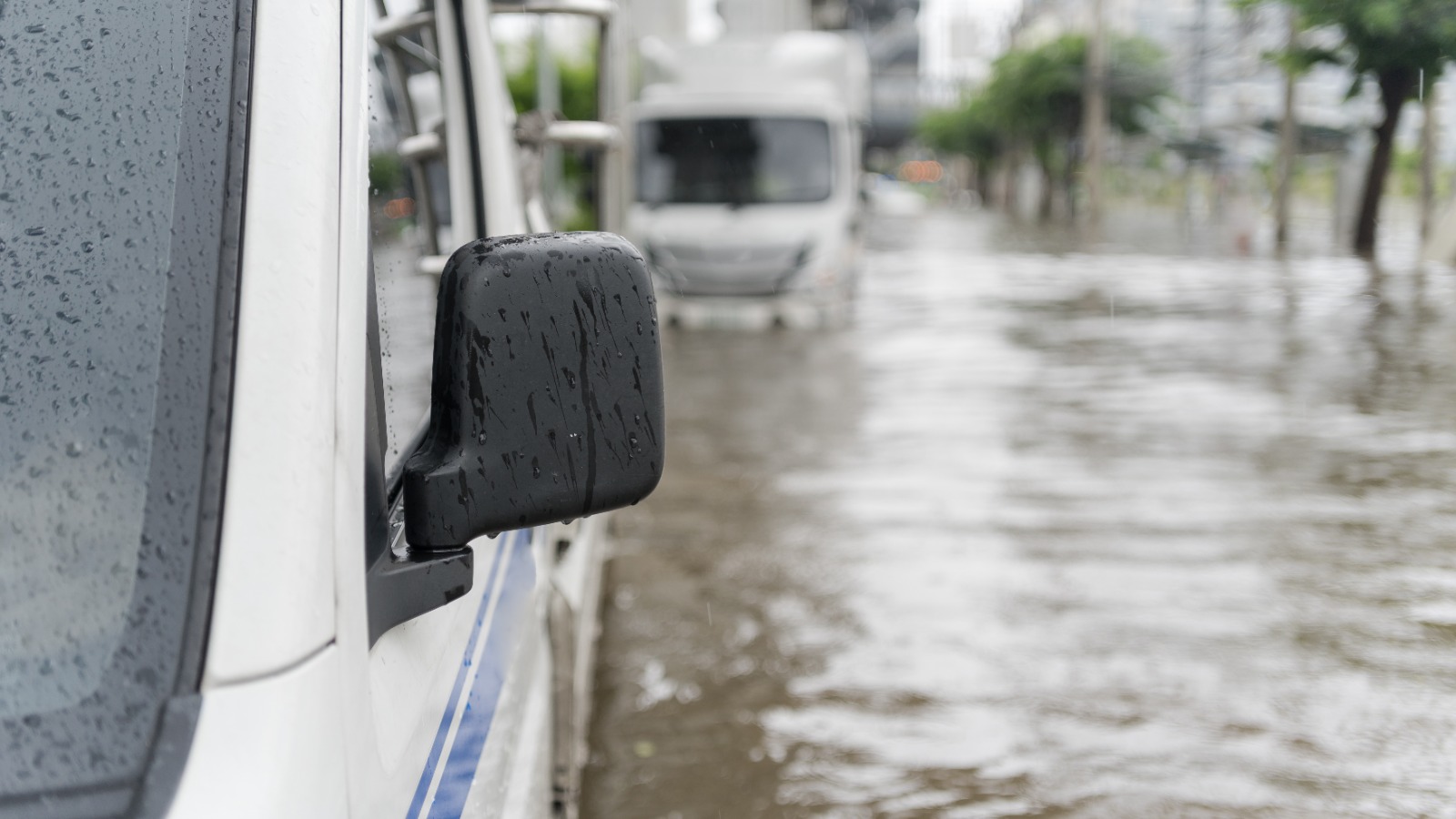
Similar considerations apply to other Nigerian cities. Port Harcourt, for example, faces flood exposure associated with low-lying terrain, rapid urban expansion and inadequate drainage. A September 2026 report by TheCable documented flooding affecting parts of Rukpokwu, Aba Expressway, Peter Odili Road and Ozuoba following heavy rainfall. Vehicles, houses and roads were submerged, illustrating how exposure extends beyond Lagos.
Maiduguri provides a different example. During the 2024 floods, the collapse of part of the Alau Dam following heavy rainfall caused extensive flooding across Maiduguri Metropolitan Council and Jere. The National Emergency Management Agency reported 414,176 people affected, 389,267 displaced and 7,155 houses damaged across nine local government areas in Borno State. This illustrates the importance of dam safety, water management and infrastructure risk, alongside urban drainage.
The investment implications differ by location. Coastal cities require attention to rainfall, tidal and lagoon-related risks, while inland urban centres may face river flooding, dam-related risks and inadequate stormwater infrastructure.
For investors, this reinforces the need for location-specific climate assessments rather than relying on broad national assumptions.
4. Market Signals: Infrastructure Spending and the Growing Demand for Resilience
Nigeria's urban flood-risk challenge is creating demand for infrastructure investment, climate-risk assessment, insurance products, and improved urban planning.
Lagos demonstrates the scale of public expenditure already being directed towards drainage and flood management. An analysis of Lagos State Budget Implementation Reports for the fourth quarter of 2025 and first quarter of 2026, published by The Guardian on 1 July 2026, reported that the state spent approximately ₦106.59 billion on drainage construction, dredging and rehabilitation between 2025 and the first quarter of 2026.
The expenditure included approximately ₦48.63 billion for statewide drainage construction and dredging, ₦13.90 billion for drainage rehabilitation across local government areas, ₦13.38 billion for additional drainage construction and dredging, and ₦24.69 billion towards outstanding drainage-project liabilities. A further ₦6 billion was reportedly spent on drainage construction and dredging during the first quarter of 2026.
These figures demonstrate the scale of the public investment requirement, but expenditure alone does not establish whether flood vulnerability has declined. The recurrence of flooding despite substantial spending raises questions about drainage maintenance, project selection, land-use enforcement, construction quality and the relationship between drainage infrastructure and wider watershed management.
The market opportunity is therefore not limited to building more drainage channels. It extends to flood-risk mapping, hydrological modelling, early-warning systems, urban data infrastructure, resilient building materials, water-management technology and the maintenance of existing infrastructure.
For private investors, these areas may offer opportunities through engineering contracts, infrastructure partnerships, climate-adaptation financing and specialist technical services. However, commercial viability will depend on procurement transparency, project economics, maintenance arrangements and the capacity of public authorities to sustain long-term investment.
The more important market signal is the growing recognition that resilience must be incorporated into the design and financing of urban assets rather than treated as an emergency expenditure after damage has occurred.
5. Strategic Risks: Property Values, Business Continuity and Lending Exposure
Flooding creates several interconnected risks that can influence investment decisions over the life of an asset.
The first is property-value uncertainty. Repeated exposure to flooding can increase repair and maintenance costs, disrupt rental income and affect the attractiveness of a property to prospective buyers or tenants. Buildings may also suffer structural deterioration through prolonged water exposure, damaged electrical systems, mould, and weakened foundations.
However, the extent to which flood exposure has already translated into systematic property-price discounts across Nigerian cities remains insufficiently documented. The direction of the risk is clear, but its financial magnitude requires transaction-level property data and location-specific research.
The second risk concerns business continuity. Companies may underestimate the indirect cost of flooding because their risk assessments concentrate on physical damage to premises rather than the wider operating environment.
A warehouse may remain undamaged while access roads are submerged. A factory may have adequate internal drainage but still lose production because suppliers cannot deliver materials or employees cannot reach the site. These disruptions can affect cash flow, contractual obligations and customer relationships.
The third risk concerns lending and collateral. Financial institutions that rely on property or business assets as security may face increased exposure where those assets are located in areas with recurring flood damage.
A property that loses rental income or requires repeated repairs may become a weaker source of loan repayment. Similarly, businesses exposed to recurring operational interruptions may experience greater earnings volatility.
Banks should therefore consider whether conventional credit assessments adequately capture physical climate risks, particularly for long-term loans and infrastructure financing.
This does not mean that every flood-prone property should be excluded from financing. It means that lenders need better information about the risk, the mitigation measures in place, and the financial capacity of borrowers to absorb losses.
A fourth risk is the potential mismatch between insurance coverage and actual exposure. Policies may exclude certain flood-related losses, impose deductibles, or provide coverage that is insufficient to restore damaged assets. Businesses and property owners may therefore believe they are protected while remaining exposed to substantial uninsured losses.
The central strategic concern is that flood risk can affect the financial performance of an asset long before it becomes physically unusable. It can influence maintenance expenditure, insurance availability, financing conditions and future demand.
6. Financing and Investment: The Emergence of Climate-Risk Insurance
Insurance is an important component of urban climate adaptation because it can help governments, businesses and households absorb financial shocks after a disaster.
However, traditional indemnity insurance is not the only available model. Parametric insurance provides an alternative by linking payouts to predefined indicators, such as measured rainfall, flood depth, or other independently verified triggers, rather than requiring a conventional assessment of every individual loss.
Lagos provides an important example of this approach.
In March 2026, the InsuResilience Solutions Fund announced that Lagos State had activated a parametric flood-risk insurance policy capable of protecting up to four million vulnerable people and providing up to US$7.5 million for flood response and recovery.
The programme was developed through cooperation involving the Lagos State Government, the United Nations Development Programme (UNDP), the Insurance Development Forum and the German Federal Ministry for Economic Cooperation and Development, through the InsuResilience Solutions Fund. Insurance-sector participants included AXA Climate, AXA Mansard, Swiss Re, JBA Risk Management, ICEYE and African Risk Capacity.
The policy is designed to make financing available for emergency response and recovery when predefined flood conditions are met. The programme covers seven local government areas and supports activities that include disaster relief and direct cash transfers to affected communities.
Its financing arrangements also reveal an important issue for the insurance market. The Fund financed 90% of the premium in the first year, while Lagos State committed to increasing its contribution beyond 10% in the second and third years. The long-term sustainability of the arrangement will therefore depend partly on the government's capacity and willingness to assume a larger share of the premium cost.
Parametric insurance offers advantages in speed and predictability, but it also carries basis risk: the possibility that a policyholder experiences a significant loss without the predefined trigger being reached, or that a payout occurs without losses matching the amount received.
It should consequently complement rather than replace appropriate property, business-interruption and infrastructure insurance.
The Lagos initiative also should not be interpreted as evidence that the entire Nigerian insurance market has broadly repriced flood exposure. Publicly available evidence establishes the introduction of a specific state-level insurance arrangement, but does not establish an industry-wide change in premiums, exclusions, or underwriting conditions.
Nevertheless, it provides an important signal that climate-risk insurance is becoming part of the financial architecture of urban adaptation.
7. Financing and Investment: The Role of Private Capital
The scale of Nigeria's flood-risk exposure means public spending alone is unlikely to meet all the financing requirements for resilient urban development.
Public authorities have responsibility for major drainage networks, flood-control infrastructure, land-use regulation and emergency management. Private capital can complement these efforts through investment in resilient commercial property, industrial facilities, logistics infrastructure, insurance solutions and specialist engineering services.
Several financing approaches could support this transition.
Public-private partnerships can help finance major drainage, water-management and flood-control projects where responsibilities, revenue arrangements and long-term maintenance obligations are clearly defined.
Climate-resilient infrastructure finance can support transport networks, industrial facilities and commercial developments designed to withstand identified physical risks.
Insurance and risk-transfer instruments can provide financial protection against losses that cannot be prevented entirely through infrastructure investment.
Blended finance can combine public funding, development finance and private investment to support projects whose wider economic benefits may not be fully captured by commercial revenue.
Resilience-linked lending can encourage companies and property developers to incorporate measurable adaptation improvements into financed projects, subject to credible monitoring and assessment.
The investment case must nevertheless account for the difference between prevention and recovery. Financing a drainage system that reduces flood exposure may generate economic benefits over many years through avoided damage and improved business continuity. However, those benefits may not translate directly into cash flows for a private investor unless a suitable financing and repayment structure exists.
This makes project preparation, public-sector coordination and transparent procurement essential.
Investors also need reliable information on expected project costs, flood-risk reduction, maintenance requirements and the economic value of protected assets.
Without these foundations, resilience projects may struggle to attract long-term capital even where the underlying need is substantial.
8. Recommendations: What Executives, Investors and Policymakers Should Do
The transition towards climate-resilient urban investment requires action across the public and private sectors.
For corporate executives:
Incorporate physical climate-risk assessments into business continuity and enterprise risk management.
Map the exposure of warehouses, factories, offices, suppliers and transport routes to flood hazards.
Review insurance policies to establish whether flood damage, business interruption and related losses are adequately covered.
Develop operational contingency plans for disruptions to electricity, transport, water supply and logistics.
Include adaptation expenditure in long-term capital planning rather than treating it solely as an emergency cost.
For property developers and investors:
Conduct location-specific flood-risk assessments before acquiring land or financing developments.
Evaluate drainage capacity, historical flood exposure, elevation, land-use conditions and proximity to waterways.
Incorporate appropriate resilient design, including raised critical electrical systems, flood-resistant materials, and improved stormwater management.
Evaluate long-term maintenance expenditure and insurance availability when calculating project returns.
Require independent technical assessments for large developments in exposed locations.
For banks and financial institutions:
Integrate physical climate risks into collateral valuation and credit assessments.
Develop more detailed geographical exposure data for property and business lending.
Assess the vulnerability of borrowers' operations and supply chains.
Work with insurers and risk-modelling providers to improve access to reliable flood-risk information.
Consider financing structures that support measurable resilience improvements.
For insurers and policymakers:
Improve access to reliable flood-hazard data and historical loss information.
Expand suitable insurance products while clearly communicating exclusions, triggers and limitations.
Strengthen drainage maintenance, land-use enforcement and protection of natural waterways.
Publish transparent information on flood-control expenditure and project performance.
Improve coordination between meteorological agencies, hydrological institutions, emergency-management authorities and urban planners.
These measures should be supported by measurable indicators, including reductions in flood-related business interruption, improvements in drainage performance, insurance coverage, infrastructure resilience and the time required for affected communities and businesses to recover.
9. Executive Outlook: From Disaster Response to Climate-Resilient Investment
Nigeria's urban flood exposure is likely to remain an important consideration for investment decisions as cities expand and infrastructure requirements increase.
Climate change can intensify certain rainfall extremes and coastal risks, but flooding is not explained by climate change alone. Land-use decisions, drainage capacity, waste management, infrastructure maintenance, floodplain development and institutional coordination also influence the severity of individual events.
For Lagos, the challenge is particularly complex because climate exposure interacts with population growth, commercial concentration and infrastructure demand. The state's parametric insurance initiative and ongoing drainage expenditure demonstrate that adaptation is beginning to receive greater financial and institutional attention.
However, the success of these measures will depend on whether they produce measurable reductions in exposure and losses. Insurance can provide liquidity after a flood, but it cannot substitute for effective drainage, responsible land management or resilient construction.
The same principle applies to private investment. Developers may incorporate flood protection into individual projects, but the value of those investments will remain affected by the condition of surrounding roads, drainage systems and public infrastructure.
The next stage of Nigeria's climate adaptation strategy should therefore connect public infrastructure investment, private-sector risk management, insurance development and urban planning within a coordinated resilience framework.
For businesses and investors, flood risk should no longer be treated as an occasional operational inconvenience. It is a factor that can influence asset performance, financing conditions, insurance protection and the long-term competitiveness of urban locations.
The economic value of climate resilience will ultimately be measured not by the amount spent after flooding occurs, but by the losses avoided, the businesses kept operational and the value of infrastructure and communities protected.
Sources & Methodology
A. Principal sources
The following sources underpin the article's factual claims and analytical framework.
1. World Bank — Assessment of Flood and Drought Risk Management in Nigeria: Through the EPIC Response Framework.
Used for national flood-loss estimates, infrastructure damage, agricultural losses, and the institutional and financing challenges affecting flood and drought risk management.
2. National Bureau of Statistics — Nigeria Flood Impact, Recovery and Mitigation Assessment Report 2022–2023.
Used for household-level flood impacts, geographical differences, livelihood losses, and recovery challenges across the six surveyed states.
https://www.nigerianstat.gov.ng/elibrary/read/1241417
3. Nigerian Institute of Social and Economic Research — PALM-TREEs Brief: Reducing Flood Risk in Lagos: Protecting Vulnerable Communities and Livelihoods.
Used for Lagos's seasonal flood patterns, exposed communities, drainage constraints, and the relationship between urbanisation, land use, and flood vulnerability.
4. InsuResilience Solutions Fund — Lagos State Goes Live with Parametric Flood Insurance Policy, Protecting up to 4 Million People (26 March 2026).
Used for the Lagos parametric flood-insurance programme, its potential coverage, US$7.5 million risk-financing limit, participating institutions, and premium-financing structure.
5. The Guardian Nigeria — Coastal States Wary as Floods Disrupt Lagos Economy Amid Disease Fears (1 July 2026).
Used for reporting on Lagos's drainage expenditure, reported business disruption, and expert estimates of the economic consequences of flooding.
https://guardian.ng/featured/coastal-states-wary-as-floods-disrupt-lagos-economy-amid-disease-fears/
6. TheCable — Vehicles, Houses, Roads Submerged as Flood Hits Port Harcourt (28 September 2026).
Used as a contemporary example of urban flooding outside Lagos and the vulnerability of residential and transport infrastructure in Port Harcourt.
https://www.thecable.ng/vehicles-houses-roads-submerged-as-flood-hits-port-harcourt/
7. National Emergency Management Agency — Flood Dashboard 2024.
Used for the reported impact of the 2024 Maiduguri and Jere flooding, including affected and displaced populations and damaged housing.
https://nema.gov.ng/flood-alert-2024/
8. Foreign, Commonwealth & Development Office / Institute of Development Studies — Urban Flood Risks, Impacts, and Management in Nigeria.
Used for background on the structural drivers of urban flooding, including inadequate drainage, unplanned development, waste management, and institutional coordination. Its evidence review dates from 2021 and is used for background rather than current loss estimates.
B. Research methodology
This article follows Aldrenor's Premium Intelligence methodology, connecting environmental risks with business performance, investment decisions, financial exposure and public policy.
1. Evidence-based research
The research prioritises official government publications, national statistical data, international development institutions and established research organisations. Contemporary media reporting is used to establish specific developments and provide additional context.
2. Economic impact assessment
Flooding is examined through its direct and indirect economic effects:
Direct damage to buildings, roads, equipment and other physical assets.
Business interruption, reduced productivity and supply-chain disruption.
Increased maintenance, repair and insurance costs.
Potential changes in property valuation and investment returns.
Additional public expenditure on emergency response and infrastructure rehabilitation.
3. Geographical comparison
Lagos is the principal case study because of its commercial significance and coastal exposure. Port Harcourt and Maiduguri are included to illustrate different geographical and infrastructure-related sources of flood risk.
The analysis does not assume that every city faces identical climate conditions or financial exposure.
4. Financial and insurance analysis
The article examines the relationship between flood exposure, property risk, insurance coverage, risk-transfer instruments, and lending decisions. The Lagos parametric insurance programme is treated as a documented example of climate-risk financing, not evidence of universal insurance-market repricing.
5. Distinction between observed losses and projections
Historical loss estimates are identified by their reporting period and geographical coverage. Government and expert estimates are attributed to their respective sources. Future climate-related losses and potential investment implications are treated as projections or analytical risks rather than confirmed outcomes.