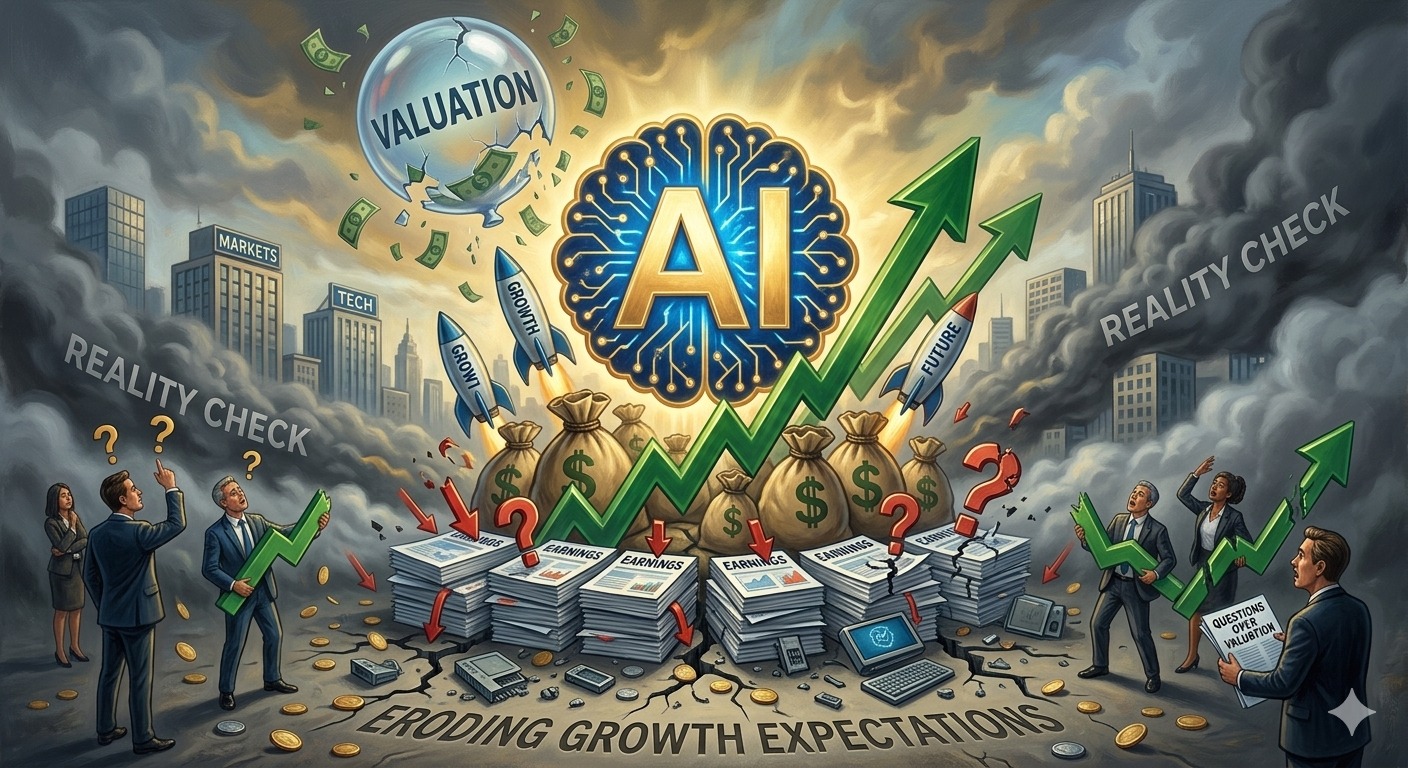
After two years of extraordinary market enthusiasm surrounding AI-related companies, recent earnings reports across the technology sector have highlighted growing scrutiny of revenue generation, capital expenditure requirements and the pace at which AI investments can translate into sustainable business returns.
Technology firms remain among the largest beneficiaries of investor interest, supported by strong demand for advanced computing infrastructure, semiconductors, cloud services and enterprise AI applications. However, market participants are increasingly questioning whether current valuations fully reflect the operational and financial realities of scaling these technologies.
The debate reflects a broader transition in financial markets. During the early stages of technological disruption, investors often focus on growth potential and market leadership. As industries mature, attention tends to shift toward profitability, competitive positioning and execution capability.
Several leading technology companies have announced significant investments in AI infrastructure, data centres and research initiatives, committing billions of dollars to secure long-term competitive advantages. While these investments may strengthen future growth prospects, they are also increasing pressure on management teams to demonstrate measurable returns.
Analysts note that AI remains one of the most transformative technologies of the modern economy, with applications extending across finance, healthcare, manufacturing, logistics and public services. The question facing investors is no longer whether AI will reshape industries, but how quickly businesses can convert innovation into commercial performance.
The reassessment is influencing capital allocation decisions across venture capital, private equity and public markets. Investors are becoming more selective, favouring companies with clear revenue strategies, operational discipline and defensible market positions.
For business leaders, the message from markets is increasingly clear: enthusiasm alone is no longer sufficient. In the next phase of the AI revolution, execution, profitability and measurable outcomes may prove as important as innovation itself.