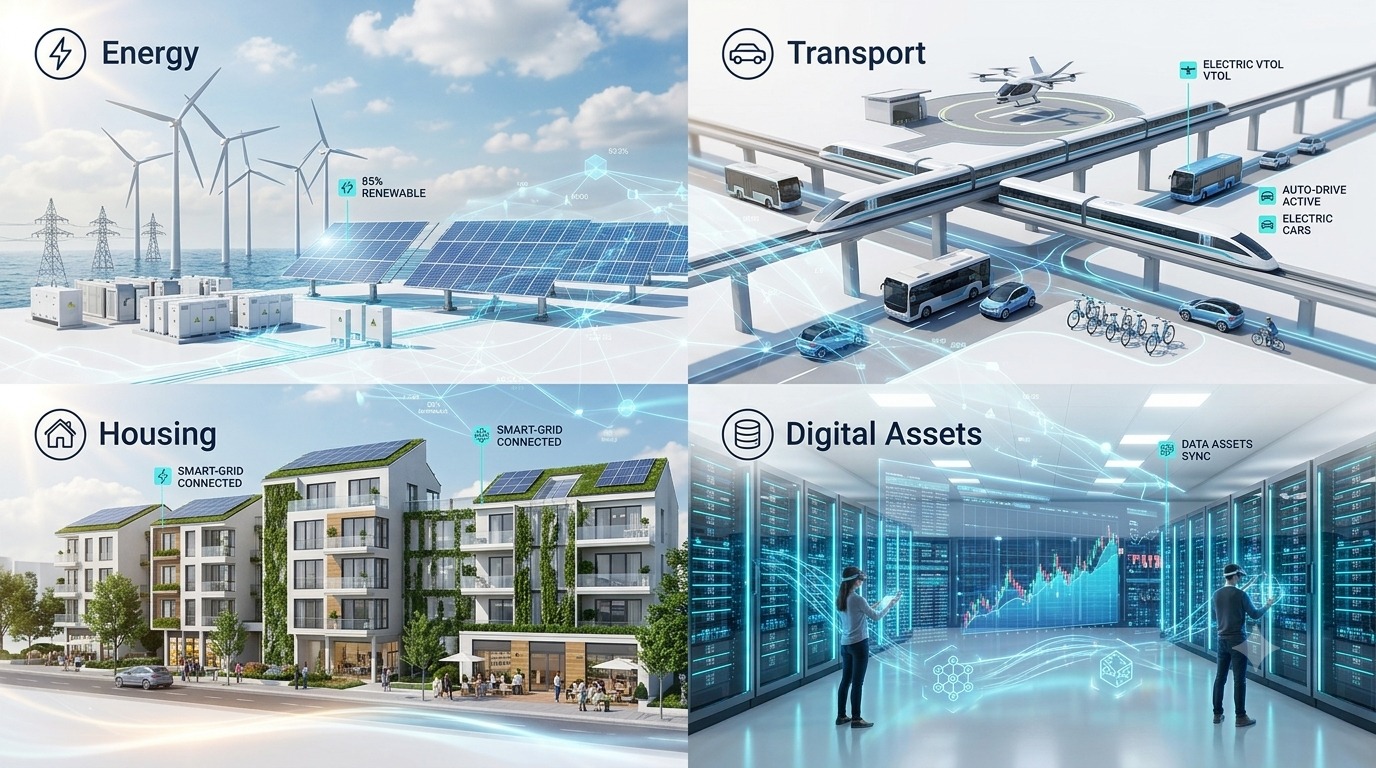
Africa's infrastructure deficit is often presented as a shortage of roads, electricity, housing and connectivity. For investors and executives, that framing is incomplete.
The more important story is the emergence of a continent-wide infrastructure investment cycle in which energy systems, transport corridors, urban housing and digital networks are increasingly becoming interconnected economic assets.
Africa needs infrastructure at a scale that public budgets alone cannot finance. The African Development Bank estimates that the continent faces an annual development financing gap of roughly $400 billion, while its earlier structural-transformation assessment estimated that transport alone represented about 72.9% of the infrastructure-related financing gap, followed by energy and productivity-enhancing technologies.
At the same time, the nature of the opportunity is changing.
Infrastructure is no longer simply about building physical assets. The most valuable projects increasingly sit at the intersection of power generation, logistics, urbanisation, digital connectivity, industrialisation and financial infrastructure.
A solar project can power an industrial park.
A transport corridor can connect factories to ports.
Affordable housing can create demand for power, water, mobility and digital services.
Fibre networks can connect households, businesses, schools and health facilities while creating the platform for digital commerce.
The investment question is therefore shifting from “How large is Africa's infrastructure deficit?” to “Which infrastructure assets can generate durable economic returns while solving the continent's most consequential bottlenecks?”
That is the central opportunity.
Executive Summary
Africa is approaching an infrastructure inflection point.
The continent's population is expanding, cities are growing, regional trade is becoming more integrated and businesses are increasingly dependent on reliable electricity and digital connectivity. Yet infrastructure investment has not kept pace with these structural changes.
The resulting gap is large, but so is the potential market.
In energy, almost 600 million people in sub-Saharan Africa lacked access to electricity in 2024, according to the International Energy Agency (IEA). Achieving universal electricity access by 2035 would require approximately $150 billion of cumulative investment, or around $15 billion annually, across grid expansion, mini-grids and standalone solar systems.
The wider energy investment picture is equally revealing. Africa accounts for roughly one-fifth of the world's population but only around 2% of global clean-energy investment, according to the IEA. In 2025, overall energy investment on the continent remained well below its 2015 level, while currency depreciation and higher interest rates continued to constrain access to capital.
Transport presents another major opportunity.
Africa's economic integration depends on moving goods and people more efficiently across borders. The African Development Bank's 2026 development review highlights corridor-based infrastructure, cross-border connectivity and regional transport systems as central to reducing fragmentation and strengthening regional value chains.
Housing is becoming equally strategic.
Africa's urban population is expanding rapidly, while formal housing supply, land administration, municipal infrastructure and affordable mortgage finance remain inadequate in many markets. The opportunity therefore extends beyond property development into land systems, construction materials, infrastructure-enabled housing, urban transport and climate-resilient communities.
Digital infrastructure is becoming the fourth pillar.
Fibre networks, mobile broadband, cloud infrastructure, data centres, digital payments and related assets are increasingly essential to economic productivity. Nigeria's BRIDGE/D-VIBE programme provides an example of the scale involved: the African Development Bank approved $200 million in April 2026 to support a project targeting approximately 90,000 kilometres of open-access fibre, expanding the national backbone from around 30,000 km to approximately 120,000 km and connecting all 774 local government areas.
These developments point towards a broader conclusion:
Africa's next infrastructure cycle will be defined less by isolated projects and more by interconnected platforms that unlock economic activity around them.
For investors, this changes where value should be sought.
For governments, it changes how projects should be designed.
For infrastructure developers, it changes what constitutes a bankable asset.
And for businesses, it creates opportunities to participate in infrastructure value chains without necessarily owning the underlying physical asset.
Why Infrastructure Matters Now
Infrastructure has always been fundamental to economic development. What has changed is the scale and urgency of the demand.
Africa is simultaneously experiencing urbanisation, industrialisation, demographic expansion, digitalisation and regional economic integration.
Each trend increases infrastructure requirements.
A growing manufacturing sector requires dependable electricity and freight networks.
Growing cities require housing, transport, water and municipal services.
Digital businesses require fibre, data centres and reliable power.
Regional trade requires ports, roads, railways and border infrastructure.
Renewable-energy deployment requires transmission networks, storage and grid modernisation.
This creates an infrastructure multiplier.
The value of a power plant is not limited to electricity sales. Its wider economic value may include the factories it enables, the jobs it supports and the businesses that depend on reliable power.
Likewise, the economic value of a transport corridor extends beyond tolls or freight charges. A functioning corridor can reduce delivery times, expand regional markets and make previously uncompetitive manufacturing projects viable.
This is why infrastructure should increasingly be assessed according to the economic activity it unlocks, not simply the physical asset being constructed.
The Financing Constraint Is Becoming the Investment Thesis
The scale of Africa's infrastructure requirement is widely understood.
The more difficult question is how to finance it.
The African Development Bank has placed the continent's annual development financing gap at approximately $400 billion and is advocating a new financial architecture designed to mobilise domestic savings, strengthen guarantee mechanisms, deepen local capital markets and reduce reliance on traditional external financing.
This matters because infrastructure requires long-duration capital.
Yet many African economies face high borrowing costs, constrained fiscal space and currency volatility. The IEA estimates that debt-servicing costs in Africa were equivalent to more than 85% of total energy investment in 2025, illustrating the pressure placed on governments and developers by expensive capital.
The implication is significant:
Africa does not simply need more infrastructure capital. It needs better infrastructure finance.
That means greater use of:
blended finance;
guarantees and political-risk instruments;
local-currency financing;
project-finance structures;
infrastructure funds;
pension and institutional capital;
green and sustainability-linked bonds;
securitisation;
diaspora-backed investment;
public-private partnerships; and
carefully targeted concessional finance.
The emerging opportunity is therefore partly a financing opportunity: institutions capable of converting high-risk infrastructure projects into investable assets may become as strategically important as the developers constructing them.
Four Infrastructure Markets to Watch
1. Energy: From Access Deficit to Productive Power
Energy is the foundation of the infrastructure opportunity.
Without reliable electricity, Africa's manufacturing ambitions, digital economy and urban development cannot scale efficiently.
The access challenge remains substantial. The IEA estimates that around 600 million people in sub-Saharan Africa lacked electricity access in 2024, with rural communities disproportionately affected. It estimates that approximately $15 billion of annual investment would be required to achieve universal access by 2035 under its ACCESS scenario.
But the opportunity is broader than connecting households.
The next stage of Africa's energy investment cycle will increasingly centre on productive electricity, power that supports factories, mines, logistics hubs, commercial districts, hospitals, data centres and other economic activity.
That creates several investable themes:
Distributed Energy
Mini-grids, solar home systems and commercial-and-industrial solar can address markets where conventional grid expansion is slow or uneconomic.
The IEA's universal-access pathway envisages roughly $5 billion annually for mini-grids and $3 billion for solar home systems, alongside approximately $7 billion for grid expansion.
Renewable Generation
Africa possesses significant renewable resources, including solar, hydro, wind and geothermal.
The investment challenge is increasingly about converting those resources into bankable projects with credible offtakers, transmission access and appropriate risk allocation.
Transmission and Grid Modernisation
Generation without transmission creates stranded capacity.
As renewable generation expands, countries will require stronger transmission networks, better grid management, storage and regional interconnection.
This is particularly important as African power markets become more interconnected.
Energy for Industry
Perhaps the most commercially significant opportunity lies in supplying reliable power directly to productive economic clusters.
Industrial parks, mines, manufacturing facilities, logistics centres and data infrastructure increasingly require power solutions tailored to their operating requirements.
This creates opportunities for developers that can combine generation, storage, distribution and long-term power contracts.
2. Transport: The Infrastructure Behind Regional Trade
If energy is the foundation of production, transport is the infrastructure of commerce.
Africa's economic geography remains constrained by long distances, fragmented markets and expensive cross-border logistics.
The strategic opportunity is therefore shifting towards corridor infrastructure.
Ports, railways, roads, inland dry ports, logistics parks and border facilities should increasingly be evaluated as connected systems rather than independent projects.
The African Development Bank's 2026 assessment highlights regional corridors as a mechanism for connecting markets, lowering transport costs and supporting regional value chains.
The most valuable corridors will be those connecting:
production → processing → logistics → ports → international markets.
That creates opportunities across several asset classes:
toll roads and bridges;
rail freight;
ports and terminals;
logistics parks;
warehousing;
cold-chain infrastructure;
border facilities;
urban mass transit;
fleet electrification; and
logistics technology.
The strategic opportunity is particularly strong where transport infrastructure intersects with industrialisation.
A new road that simply shortens a journey has value.
A transport corridor that enables a manufacturing cluster, agricultural-processing zone or export hub can create significantly greater economic value.
Investment Signal
The strongest infrastructure opportunities are increasingly likely to be found where multiple infrastructure systems converge.
A power project connected to an industrial zone is more strategically significant than generation capacity considered in isolation.
A railway connected to a port and manufacturing corridor is more valuable than a standalone railway.
Affordable housing connected to transport, power, water and digital networks creates a stronger urban asset than housing built without supporting infrastructure.
Fibre connected to data centres, financial services, businesses and public institutions creates a broader digital economic platform.
This interconnected approach should become central to how investors evaluate Africa's infrastructure pipeline.
The infrastructure opportunity is not simply about building more.
It is about building assets that make other assets more productive.
3. Housing: The Urban Infrastructure Opportunity
Housing is often treated as a real-estate problem.
For Africa, it is increasingly an infrastructure and economic productivity problem.
Rapid urbanisation is creating demand not only for homes, but for the infrastructure that makes urban communities economically functional: electricity, water, sanitation, roads, public transport, broadband, schools, healthcare and commercial space.
IFC's assessment of Africa's housing market estimates a shortfall of at least 51 million housing units, alongside a significant housing-finance gap. It also projects that Africa's housing deficit could reach approximately 130 million units by 2030 if supply does not accelerate.
The scale of the deficit creates a substantial long-term market.
But the opportunity is not simply to build more houses.
It is to build infrastructure-enabled urban communities.
Affordable Housing Is Becoming an Infrastructure Asset Class
The financing challenge is one of the most important constraints.
Developers face high construction costs, expensive financing and limited access to long-term capital, while households often lack mortgages with sufficiently long maturities and affordable interest rates.
This creates a structural mismatch:
demand is long-term, but financing is frequently short-term and expensive.
The investment response is beginning to change.
In Côte d'Ivoire, IFC provided local-currency financing equivalent to $27 million to support the development of approximately 5,600 affordable homes in Greater Abidjan. The project is expected to benefit more than 23,000 people.
In South Africa, IFC committed ZAR1 billion to support the development of more than 16,000 homes for low- and middle-income buyers near Johannesburg.
These transactions illustrate an important shift.
Affordable housing is increasingly being treated as an investable infrastructure opportunity that can attract institutional and development capital when projects have credible structures, local-currency financing and identifiable demand.
The Bigger Opportunity Is the Housing Ecosystem
The housing opportunity extends across the entire value chain.
Investors can participate in:
affordable residential development;
mortgage finance;
housing-finance institutions;
mortgage refinancing;
construction materials;
modular and industrialised construction;
water and sanitation;
urban power;
transport connections;
green buildings;
property technology;
land and title systems;
rental housing; and
community infrastructure.
This creates multiple routes into the same structural opportunity.
A developer does not necessarily need to own every component.
Banks can finance mortgages.
Infrastructure funds can finance utilities.
Construction companies can provide modular systems.
Technology companies can digitise land, payments and property management.
Energy companies can supply distributed power.
Transport operators can connect new residential districts to employment centres.
The most sophisticated investors will therefore assess housing as part of a broader urban infrastructure platform.
4. Digital Infrastructure: The New Economic Utility
Digital infrastructure has moved from being a technology-sector issue to becoming a core economic infrastructure requirement.
Fibre networks, mobile broadband, cloud infrastructure, data centres, digital public infrastructure, subsea cables and secure data systems increasingly determine whether businesses can participate in the modern economy.
The World Bank notes that digitalisation across Africa remains constrained by limited connectivity, inadequate data infrastructure, high costs of devices and data, and cybersecurity and data-protection challenges.
This creates a large infrastructure market.
But the opportunity is changing from simply connecting people to building the digital foundations of economic activity.
Fibre Is Becoming Strategic Infrastructure
Fibre networks are increasingly comparable to roads and electricity networks in economic importance.
They connect households, businesses, schools, hospitals, financial institutions, government agencies and industrial zones.
Nigeria provides a useful illustration of the scale now being contemplated.
In April 2026, the African Development Bank approved $200 million for Nigeria's D-VIBE/BRIDGE digital infrastructure project, which aims to deploy approximately 90,000 kilometres of open-access fibre, expand the national fibre backbone from around 30,000 kilometres to about 120,000 kilometres and connect all 774 local government areas.
The World Bank separately approved $500 million for the broader BRIDGE programme in 2025. The project is structured around a privately operated special-purpose vehicle and is expected to deploy more than 90,000 kilometres of fibre while connecting millions of households and public institutions.
The commercial significance is considerable.
A national fibre network creates opportunities for:
telecom operators;
internet service providers;
cloud providers;
data centres;
fintech companies;
digital commerce;
cybersecurity firms;
artificial-intelligence infrastructure;
enterprise software;
digital public services; and
cross-border digital trade.
The infrastructure therefore creates a platform upon which an entire digital economy can develop.
Data Centres and Cloud Infrastructure
The next layer of the digital opportunity is data.
As African businesses digitise, governments move public services online and AI adoption increases, demand for local computing, storage and data-processing capacity will rise.
This creates opportunities in:
hyperscale and enterprise data centres;
edge computing;
cloud infrastructure;
data storage;
cybersecurity;
disaster recovery;
subsea cable landing infrastructure;
fibre backhaul; and
renewable-powered digital infrastructure.
The economics of these assets, however, are closely tied to energy.
Data centres require reliable electricity, cooling and connectivity.
This creates one of the clearest examples of infrastructure convergence.
Energy investment enables digital infrastructure; digital infrastructure increases demand for energy.
Investors that understand this relationship can evaluate combined energy-and-digital projects rather than treating the two sectors as independent markets.
Digital Public Infrastructure
The opportunity also extends beyond privately owned telecommunications infrastructure.
Digital identity, payments, interoperable data systems and secure public digital platforms are becoming foundational infrastructure for modern economies.
The World Bank's Global Digital Public Infrastructure programme reports that 2.9 billion people globally, predominantly in sub-Saharan Africa and South Asia, lack digital IDs suitable for online transactions. It also identifies substantial gaps in fast and inclusive payment systems in lower- and middle-income countries.
For Africa, digital public infrastructure can reduce transaction costs and improve the efficiency of:
government services;
financial inclusion;
tax collection;
social protection;
healthcare;
education;
business registration;
cross-border trade; and
digital payments.
This means digital infrastructure is increasingly becoming part of the institutional infrastructure of economic development.
The Convergence Opportunity
The most compelling infrastructure opportunities increasingly sit between sectors.
Energy + Digital
Renewable power and grid infrastructure can support data centres, telecom towers and digital businesses.
Energy + Housing
Affordable housing projects can integrate distributed solar, efficient appliances, battery storage and smart energy systems.
Transport + Housing
Urban housing becomes more commercially viable when connected to reliable public transport and employment centres.
Transport + Trade
Ports, railways, roads and logistics parks can create regional production corridors rather than simply improving mobility.
Digital + Trade
Fibre networks, digital payments and electronic customs systems can reduce the friction involved in cross-border commerce.
Energy + Industry
Reliable electricity can unlock manufacturing, processing and industrial parks, creating demand for additional logistics and housing infrastructure.
This convergence changes the way projects should be evaluated.
A project should not be assessed only according to its direct financial return.
Investors should also ask:
What economic activity will this infrastructure unlock?
Where the Investment Opportunity Is Concentrating
The infrastructure opportunity is not evenly distributed across the continent.
Capital is more likely to find attractive risk-adjusted opportunities where several conditions overlap:
Large and Growing Demand
Markets with significant population growth, urbanisation and industrial demand can provide stronger long-term utilisation.
Credible Offtakers
Infrastructure projects become more bankable when developers can demonstrate reliable customers willing to enter long-term contracts.
Policy Stability
Predictable regulation, transparent procurement and credible institutions reduce political and execution risk.
Regional Connectivity
Projects connected to multiple markets can achieve greater scale than infrastructure serving a single isolated economy.
Local-Currency Financing
Projects generating local-currency revenues are particularly vulnerable to currency mismatch when financed predominantly in hard currency.
Recent financing initiatives demonstrate the importance of solving this problem. In May 2026, IFC and the West African Development Bank announced reciprocal euro and West African CFA franc facilities totalling up to €600 million, designed to expand long-term local-currency financing across sectors including energy, transport and urban development in the WAEMU region.
Strategic Implication
For investors, the central opportunity is not simply finding Africa's next infrastructure project.
It is identifying infrastructure platforms capable of becoming economic ecosystems.
For governments, the priority should be designing projects around economic corridors, productive clusters and urban systems rather than isolated assets.
For businesses, infrastructure gaps should be treated as potential markets.
And for development-finance institutions, the highest-impact role may increasingly be to structure projects so that commercial capital can participate at scale.
Africa's infrastructure cycle is therefore entering a more sophisticated phase.
The question is moving from how much infrastructure Africa needs to which infrastructure can generate sustainable economic value, who can finance it and how the assets can be connected into investable systems.
The Investment Case: Where Capital Can Create the Most Value
Africa's infrastructure opportunity is large, but size alone does not make an infrastructure asset investable.
The decisive question is whether a project can convert economic demand into predictable cash flows while managing political, currency, construction and regulatory risk.
This distinction is becoming increasingly important as governments face tighter fiscal conditions and development assistance becomes less predictable.
The African Development Bank's 2026 outlook has placed greater emphasis on mobilising domestic resources and attracting long-term private capital as African economies navigate higher debt burdens and global uncertainty.
For infrastructure investors, this creates a market in which project structuring becomes as important as project construction.
The strongest opportunities share five characteristics
1. They solve a measurable economic bottleneck
Infrastructure becomes commercially compelling when it addresses a constraint that businesses or households are already paying to overcome.
Examples include:
unreliable electricity;
expensive freight;
inadequate housing;
weak broadband;
insufficient data capacity;
congested ports; and
limited urban mobility.
The stronger the underlying economic demand, the easier it becomes to establish a credible revenue model.
2. They have identifiable customers
Bankability improves when projects have contracted or clearly identifiable users.
For energy, this may be an industrial offtaker or utility.
For transport, it may be freight operators, passengers or concession revenues.
For digital infrastructure, it may be telecom operators, cloud providers, enterprises or government institutions.
For housing, it may be mortgage-backed buyers, institutional landlords or long-term rental demand.
3. They can attract blended capital
Projects operating in difficult markets may not initially support commercial financing on conventional terms.
Blended finance can change that equation by combining concessional funding, guarantees, development capital and private investment.
The objective should not be permanent subsidisation.
It should be risk reduction sufficient to allow commercial capital to enter and eventually scale.
The June 2026 launch of Zafiri illustrates this model. The $176 million permanent-capital vehicle combines development and private-sector investors to finance distributed renewable-energy businesses across sub-Saharan Africa, with the ambition of supporting more than 10 million new electricity connections by 2030.
4. They use appropriate currency structures
Currency mismatch remains one of the most important risks in African infrastructure.
A project earning revenues in local currency but borrowing predominantly in US dollars or euros can become financially stressed when the local currency depreciates.
The development of local-currency financing is therefore strategically significant.
The May 2026 agreement between BOAD and IFC for reciprocal euro and West African CFA franc facilities worth up to €600 million is an example of institutions attempting to deepen long-term local-currency financing across energy, transport, urban development and other sectors.
5. They can scale beyond one project
Infrastructure investors increasingly have the opportunity to build platforms rather than isolated assets.
A developer with a successful mini-grid model can replicate it across several countries.
A digital infrastructure platform can expand fibre or data-centre capacity as demand grows.
A housing-finance platform can finance multiple developments.
A logistics operator can build a network of warehouses and transport assets around major trade corridors.
Platform strategies can diversify project risk while creating operational economies of scale.
Financing the Infrastructure Cycle
The financing architecture will determine how quickly Africa can convert infrastructure demand into actual assets.
Public Capital: Necessary but Insufficient
Governments will remain important infrastructure financiers, particularly for assets with significant public-good characteristics.
Roads, transmission networks, water systems and urban infrastructure may generate economic benefits that cannot always be captured through direct user charges.
But public budgets alone cannot finance the scale required.
The African Development Bank says Africa currently invests around 4% of GDP in infrastructure, compared with approximately 14% in China, and estimates that closing the infrastructure gap could add around two percentage points to annual GDP growth.
The policy challenge is therefore to use public money strategically—to prepare projects, absorb specific risks and create conditions under which private capital can participate.
Public-Private Partnerships
Public-private partnerships are likely to become increasingly important.
Nigeria's 2026 agreement with IFC provides an indication of this direction: the government and IFC are developing a pipeline of PPP projects across transport, energy, information technology and sanitation, against an estimated $14.2 billion in annual urban infrastructure requirements over the next decade.
The significance extends beyond Nigeria.
PPP structures can allow governments to mobilise private expertise and capital while retaining public oversight of strategically important assets.
But PPPs are not automatically successful.
Poorly structured concessions can create fiscal liabilities, unaffordable tariffs or renegotiation risk.
The quality of project preparation therefore matters as much as the availability of capital.
Institutional Capital: The Missing Scale
Africa has pools of domestic capital that remain underutilised for infrastructure.
Pension funds, insurers, sovereign funds, family offices and local asset managers can potentially provide long-duration financing that better matches infrastructure's investment horizon.
The challenge is creating investment structures that meet institutional requirements for:
predictable returns;
risk diversification;
liquidity management;
governance;
transparency;
regulatory compliance; and
currency management.
Infrastructure funds and pooled investment vehicles can help aggregate smaller institutional allocations into projects large enough to achieve meaningful economic impact.
The emergence of such structures is particularly important because foreign capital alone cannot sustainably finance Africa's infrastructure transition.
Strategic Risks
The opportunity is significant, but infrastructure investment in Africa carries risks that require active management.
Currency Risk
Currency depreciation can materially affect projects with foreign-currency debt and local-currency revenues.
This is particularly relevant to housing, transport and distributed energy projects whose revenues are primarily generated domestically.
Local-currency financing, hedging mechanisms and appropriate tariff structures can reduce, but not eliminate the exposure.
Political and Regulatory Risk
Infrastructure projects often operate under concessions, licences, tariffs or long-term government agreements.
Changes in regulation, taxation, procurement rules or political leadership can alter project economics.
Investors should therefore evaluate institutional quality and regulatory predictability as core investment variables rather than secondary considerations.
Offtaker Risk
A project may be technically sound but commercially weak if its principal customer cannot reliably pay.
This is particularly important in power infrastructure, where the financial condition of utilities can determine the viability of generation projects.
Investors should examine the full payment chain rather than assessing the creditworthiness of the ultimate user alone.
Construction and Execution Risk
Large infrastructure projects frequently face:
cost overruns;
delays;
land-acquisition problems;
procurement disputes;
contractor underperformance;
imported-equipment constraints; and
changes in financing costs.
Strong project preparation, independent engineering assessments, experienced contractors and realistic contingency assumptions are therefore essential.
Climate and Physical Risk
Infrastructure built today must remain functional under changing climate conditions.
Flooding, heat, drought, coastal erosion and extreme weather can damage transport networks, power systems and urban developments.
Climate resilience should therefore be incorporated into project design rather than treated as an additional feature after construction.
This creates a secondary investment opportunity in resilient infrastructure, insurance, adaptation technology and climate-risk analytics.
The Strategic Shift: From Projects to Platforms
The next generation of African infrastructure investment is likely to be increasingly platform-oriented.
Consider the difference.
A conventional investment thesis might focus on building a solar plant.
A platform thesis asks whether the opportunity is to build an integrated energy company capable of supplying mini-grids, commercial and industrial customers, telecom infrastructure and productive-use businesses across multiple markets.
A conventional property investment might finance an apartment development.
A platform thesis could combine housing development, mortgage finance, construction materials, energy services and property technology.
A conventional telecom investment might focus on fibre deployment.
A platform strategy could combine fibre, data centres, cloud services and enterprise connectivity.
This approach can create multiple revenue streams while spreading operational and geographic risk.
It also creates a more attractive proposition for institutional investors seeking scale.
What Serious Decision-Makers Should Do Next
For Infrastructure Investors
Prioritise economic bottlenecks over headline project size.
A smaller infrastructure asset serving a high-value industrial cluster may generate superior risk-adjusted returns to a much larger project with uncertain demand.
Investors should examine:
demand certainty;
offtaker quality;
tariff structure;
currency exposure;
regulatory stability;
construction risk;
exit options; and
potential for replication.
For Governments
Build investable infrastructure pipelines rather than isolated projects.
Governments should establish transparent project-preparation mechanisms, strengthen PPP units, improve procurement systems and make land, environmental and regulatory information accessible before investors commit capital.
Project preparation can be one of the highest-return uses of public infrastructure spending because it reduces uncertainty before private capital enters.
For Development Finance Institutions
Move further upstream.
Development finance should not only provide loans after projects become bankable.
It can help make projects bankable through:
feasibility studies;
transaction advisory;
guarantees;
first-loss capital;
political-risk insurance;
currency solutions;
project preparation facilities; and
standardised investment structures.
The objective should be to create a pipeline that commercial investors can eventually finance at scale.
For African Businesses
Treat infrastructure gaps as commercial opportunities.
Companies should identify where infrastructure shortages are creating unnecessary costs for customers.
This can produce opportunities in:
distributed energy;
logistics;
cold storage;
housing finance;
construction technology;
broadband;
digital payments;
data infrastructure;
water services; and
urban mobility.
Infrastructure does not always require billions of dollars of capital.
Some of the most scalable opportunities will come from businesses that solve infrastructure bottlenecks at the operating level.
Priority Signals for Investors
Over the next three to five years, investors should monitor several indicators closely.
Energy
Watch the expansion of transmission, distributed renewable energy, storage and commercial-and-industrial power.
Mission 300 is already demonstrating the potential for coordinated investment at scale: the World Bank and African Development Bank announced in June 2026 that the initiative had connected more than 50 million people across 40 countries, moving towards its target of connecting 300 million additional people by 2030.
Transport
Monitor trade corridors connected to ports, industrial zones, mining regions and agricultural production centres.
The highest-value corridors will increasingly be those that enable regional supply chains rather than simply reduce passenger travel times.
Housing
Watch local-currency mortgage markets, institutional rental housing, affordable construction technologies and urban infrastructure financing.
Housing demand alone does not create an investable market; financing and infrastructure determine whether demand can become effective purchasing power.
Digital
Monitor fibre penetration, data-centre capacity, cloud adoption, mobile-network investment and digital public infrastructure.
Recent investment demonstrates that this market is moving rapidly. In July 2026, IFC announced a $150 million loan to Airtel Africa subsidiaries to expand and modernise mobile networks and extend high-speed connectivity in underserved communities.
Integrated Projects
Most importantly, watch projects where sectors converge.
Industrial parks with dedicated energy.
Housing connected to mass transit.
Ports connected to logistics zones.
Fibre connected to data centres.
Renewable energy connected to digital infrastructure.
These combinations may produce the strongest long-term infrastructure economics.
Executive Outlook
Africa's infrastructure opportunity is entering a more investable phase—but not because the infrastructure deficit is disappearing.
It is becoming more investable because the mechanisms for financing, structuring and operating infrastructure are becoming more sophisticated.
Development finance institutions are increasingly using guarantees, blended finance and local-currency structures to crowd in private capital.
Governments are expanding PPP pipelines.
Private investors are moving towards platform strategies.
Digital infrastructure is creating new asset classes.
Renewable energy is opening distributed and commercial-and-industrial markets.
Housing is becoming increasingly connected to urban infrastructure and finance.
Transport is being repositioned around regional trade corridors.
The result is a market in which infrastructure should increasingly be understood as an interconnected system of economic assets.
For investors, the opportunity is to identify projects with strong demand, credible counterparties and scalable economics.
For governments, the priority is to create predictable investment environments and prepare bankable pipelines.
For development institutions, the opportunity is to use limited concessional resources to unlock much larger pools of private capital.
And for African businesses, the infrastructure deficit itself can become a source of enterprise creation.
The central investment thesis is therefore straightforward:
Africa does not simply need more infrastructure. It needs infrastructure that makes the rest of the economy more productive.
That distinction will determine where the next generation of infrastructure capital flows.
Sources & Methodology
This report uses a combination of primary institutional sources and current market evidence, with particular weight given to the African Development Bank, International Finance Corporation, World Bank Group and other development-finance institutions. Current project announcements and financing transactions were used to identify emerging investment patterns across energy, transport, housing and digital infrastructure.
The analysis follows Aldrenor's Premium Intelligence methodology: identify the structural problem, quantify the opportunity where reliable data are available, assess the financing and commercial mechanisms, identify key risks, and translate those findings into implications for executives, investors, policymakers and institutions.
The report distinguishes between reported facts and Aldrenor's analytical interpretation. Where an investment opportunity is described as an emerging theme rather than an established market fact, it represents analytical assessment based on the underlying infrastructure, financing and policy trends.
The report is intended for strategic and informational purposes. It does not constitute investment, financial, legal or tax advice.