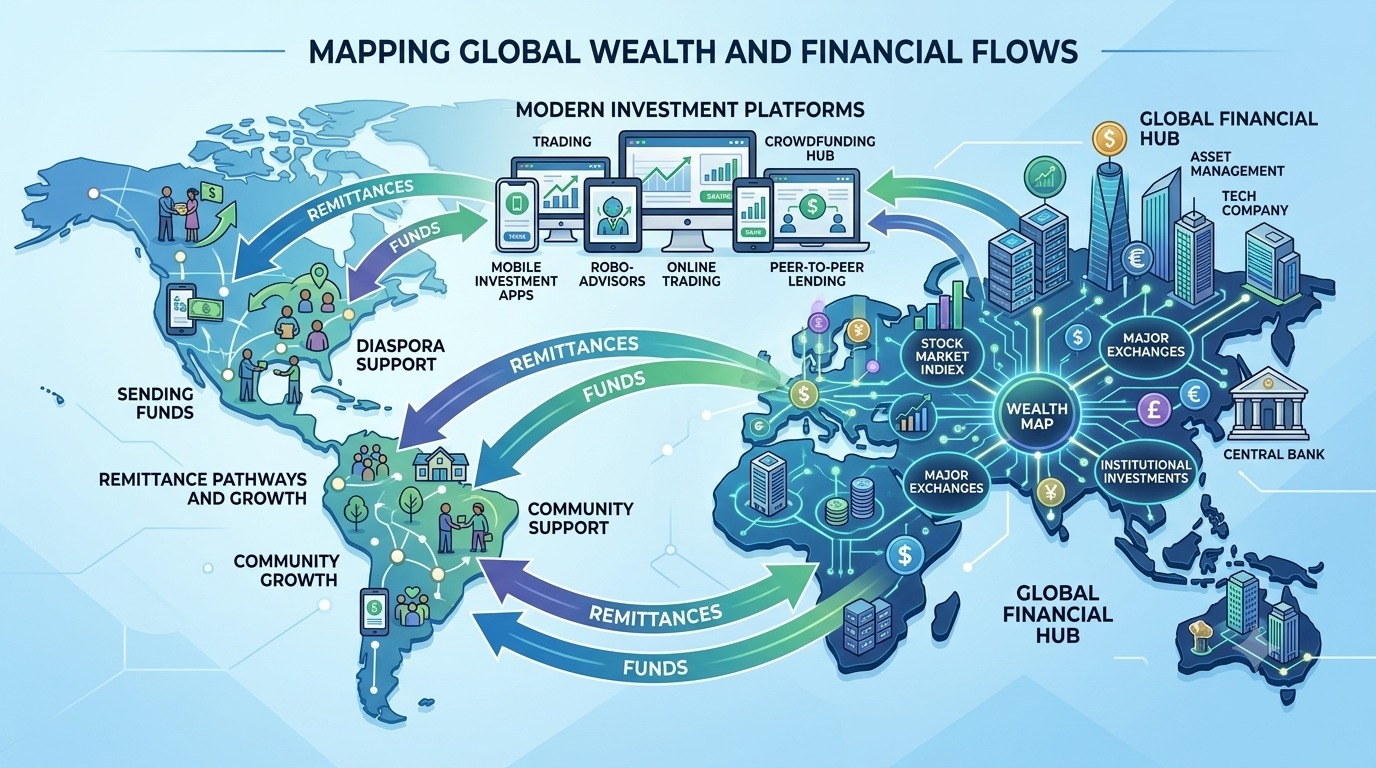
For decades, discussions around Africa's economic development have centred on foreign direct investment (FDI), development assistance and sovereign borrowing. Yet a quieter and increasingly influential source of capital has emerged as one of the continent's most resilient financial lifelines: its global diaspora.
The numbers are becoming impossible to ignore.
According to the African Development Bank (AfDB), Africa received approximately US$104.8 billion in remittances during 2024, making diaspora transfers the continent's largest source of external financing, ahead of both official development assistance and foreign direct investment. Over the past quarter century, remittance inflows have increased almost tenfold, while Africa's diaspora population has expanded to an estimated 45.8 million people living abroad.
Yet remittances represent only one dimension of Africa's diaspora economy.
Across North America, Europe, the Gulf states and Asia, African professionals, entrepreneurs, investors and business leaders are accumulating wealth, managing investment funds, building multinational companies and increasingly seeking opportunities to reconnect economically with their countries of origin.
This presents an important strategic question.
Can Africa transform diaspora capital from predominantly household consumption into long-term productive investment?
If successfully mobilised, diaspora wealth could become a major source of financing for infrastructure, manufacturing, healthcare, affordable housing, technology, agribusiness, renewable energy and venture capital, while strengthening domestic capital markets and reducing dependence on external borrowing.
The challenge is no longer whether diaspora capital exists.
The challenge is creating investment ecosystems capable of attracting, retaining and scaling it.
Why It Matters
Diaspora capital has evolved from a social safety mechanism into a strategic economic asset.
Historically, remittances have primarily supported household consumption by financing education, healthcare, housing and daily living expenses.
Those contributions remain essential.
However, policymakers, development finance institutions and investors increasingly recognise that diaspora wealth possesses far greater economic potential than traditional remittance flows alone.
The opportunity lies in converting recurring transfers into productive investment.
Unlike many forms of external financing, diaspora capital often demonstrates remarkable resilience during periods of economic uncertainty.
During global crises, remittances frequently remain stable, or even increase as diaspora communities provide additional financial support to families facing economic hardship.
This consistency makes diaspora finance particularly valuable for economies vulnerable to fluctuations in commodity prices, foreign investment and development assistance.
The African Development Bank argues that although Africa's diaspora represents one of the continent's largest pools of financial resources, much of this potential remains underutilised because existing financial systems are not effectively designed to channel these resources into productive investment.
For decision-makers, the implication is significant.
The next phase of diaspora engagement should focus not simply on increasing remittance volumes but on developing sophisticated financial products capable of transforming household transfers into institutional capital.
Beyond Remittances
Diaspora capital should no longer be viewed solely through the lens of money transfers.
A broader definition includes:
Private wealth accumulated by African professionals abroad.
Diaspora-owned businesses operating internationally.
Venture capital and private equity funds established by diaspora investors.
Family offices investing across multiple African markets.
Angel investment networks supporting African entrepreneurs.
Diaspora bonds and infrastructure financing.
Knowledge transfer, technology partnerships and executive leadership.
Collectively, these assets represent a diverse financial ecosystem rather than a single funding source.
The countries that successfully mobilise these different forms of capital are likely to strengthen domestic investment while reducing dependence on more volatile external financing.
The Strategic Shift
Global capital markets are changing.
Development assistance is becoming more constrained.
International borrowing costs remain elevated.
Investors are increasingly seeking resilient frontier markets with favourable demographic and long-term growth prospects.
Against this backdrop, diaspora investors occupy a unique position.
Unlike conventional foreign investors, diaspora communities often possess deeper cultural understanding, stronger personal networks and greater confidence in local market opportunities.
These characteristics frequently allow diaspora investors to identify opportunities overlooked by traditional international capital.
This creates a competitive advantage that extends beyond finance.
Diaspora entrepreneurs often contribute management expertise, international market access, technology transfer and institutional knowledge alongside financial investment.
The result is capital that is simultaneously financial, intellectual and relational.
For Africa's long-term development, that combination may prove more valuable than finance alone.
The State of Africa's Diaspora Capital
Africa's diaspora economy is entering a new phase.
For decades, policymakers primarily viewed diaspora engagement through the lens of remittances, personal transfers supporting families with education, healthcare, housing and daily living expenses. While these flows remain indispensable, they no longer capture the full scale or sophistication of Africa's global economic footprint.
Today, Africa's diaspora represents a diverse ecosystem of entrepreneurs, institutional investors, executives, technology founders, medical professionals, academics and business leaders with growing influence across global financial centres.
The strategic opportunity therefore extends beyond remittances.
It lies in mobilising diaspora wealth, institutional capital, commercial expertise and international networks into long-term investment that accelerates Africa's structural transformation.
The African Development Bank estimates that Africa's diaspora population has expanded to approximately 45.8 million people, while remittance inflows reached US$104.8 billion in 2024, making them the continent's largest source of external finance—surpassing both foreign direct investment and official development assistance. Over the past twenty-five years, remittance inflows have increased nearly tenfold, highlighting both the growing scale and resilience of diaspora finance.
Yet the AfDB also argues that only a fraction of this financial potential is currently being channelled into productive investment.
Most transfers continue to finance household consumption rather than business expansion, infrastructure or productive assets.
For policymakers, investors and development institutions, this represents one of Africa's largest untapped pools of long-term capital.
Mapping Africa's Diaspora Wealth
Diaspora capital is not evenly distributed.
Different migration corridors have produced distinct investment profiles that influence how capital returns to Africa.
North America
African professionals in the United States and Canada increasingly occupy leadership positions across finance, healthcare, engineering, technology and entrepreneurship.
Many possess significant investable assets alongside growing interest in venture capital, private equity and technology entrepreneurship on the continent.
This has contributed to the emergence of diaspora-led angel investor networks, venture funds and startup accelerators connecting Silicon Valley, New York and Toronto with innovation hubs in Lagos, Nairobi, Cape Town, Kigali and Accra.
Europe
The United Kingdom, France, Germany, Italy and the Netherlands continue to host some of Africa's largest diaspora communities.
Historically, Europe has been the dominant source of remittance flows into West, North and East Africa.
Increasingly, however, diaspora professionals are investing through property development, SME financing, renewable energy projects, agribusiness and cross-border trade businesses.
European financial institutions are also becoming important partners for diaspora-focused investment vehicles.
Gulf States
Migration to the Gulf Cooperation Council (GCC) economies has expanded significantly over the past two decades.
Highly skilled professionals alongside migrant workers continue to generate substantial remittance flows, particularly to Egypt, Sudan, Kenya, Ethiopia and Nigeria.
Although much of this capital remains directed towards household consumption, Gulf-based investors are becoming increasingly active in infrastructure, healthcare, logistics and real estate opportunities across Africa.
Intra-African Migration
Diaspora capital is not exclusively intercontinental.
Growing migration within Africa itself is strengthening regional investment networks.
Business communities operating between South Africa, Kenya, Nigeria, Côte d'Ivoire, Ghana, Rwanda and other regional economies increasingly facilitate cross-border trade, SME investment and industrial partnerships.
This intra-African mobility complements the objectives of the African Continental Free Trade Area by supporting deeper regional economic integration.
The Largest Remittance Corridors
While remittances remain highly fragmented across countries, several corridors dominate continental inflows.
Nigeria, Egypt, Kenya, Senegal and The Gambia consistently rank among Africa's strongest performers in mobilising diaspora financial resources relative to the size of their overseas populations. According to the African Development Bank, Nigeria generated approximately US$10,167 in remittances per diaspora member during 2024, followed by Kenya, The Gambia, Egypt and Senegal, demonstrating the considerable variation in diaspora engagement across African economies.
These differences are shaped by multiple factors, including migration patterns, host-country income levels, exchange-rate policies, financial infrastructure and trust in domestic institutions.
Countries that simplify remittance channels, strengthen financial regulation and expand formal banking access generally attract higher formal inflows than those relying heavily on informal transfer networks.
Beyond Household Transfers
The most significant structural shift is occurring in how diaspora capital is being deployed.
Traditional remittances remain essential for supporting household resilience, but an increasing share of diaspora wealth is now being directed towards productive investment.
Emerging investment activity includes:
Venture capital financing for African technology companies.
Private equity investments in healthcare, education and manufacturing.
Commercial agriculture and agribusiness ventures.
Affordable housing and mixed-use property developments.
Renewable energy and climate infrastructure.
SME lending platforms.
Digital financial services.
Export-oriented manufacturing businesses.
Cross-border logistics and supply-chain infrastructure.
This transition reflects growing confidence in Africa's long-term economic prospects and the increasing sophistication of diaspora investors seeking commercial returns alongside developmental impact.
Emerging Investment Platforms
New financial platforms are beginning to reshape how diaspora investors engage with African markets.
Rather than relying solely on informal family networks, investors increasingly access structured investment opportunities through specialised funds, crowdfunding platforms, venture capital firms and digital investment marketplaces.
Governments are also experimenting with diaspora bonds, dedicated investment funds and digital savings products designed to mobilise overseas capital into infrastructure and national development priorities.
The African Development Bank argues that improving financial inclusion, expanding diaspora investment products, strengthening macroeconomic stability and developing credible investment environments will be essential if remittance flows are to become more productive sources of long-term development finance.
For financial institutions, this represents a substantial commercial opportunity.
As diaspora investors seek professionally managed, transparent and diversified investment vehicles, demand is likely to increase for specialist asset managers, infrastructure funds, venture capital platforms and blended finance instruments focused on African markets.
The question is no longer whether diaspora capital exists.
It is whether Africa can build investment platforms capable of converting one of the world's largest and most resilient financial communities into a sustained engine of economic transformation.
Where the Investment Opportunities Are
The next phase of Africa's diaspora engagement will not be defined by larger remittance flows alone. It will be determined by whether governments, financial institutions and private investors can create investable opportunities capable of attracting long-term diaspora capital.
The most attractive opportunities are those that combine commercial returns with measurable developmental impact, allowing diaspora investors to preserve family connections while participating in Africa's long-term economic growth.
Infrastructure and Energy
Africa's infrastructure financing gap remains one of the continent's largest investment opportunities.
Transport networks, power generation, water systems, digital infrastructure and logistics corridors require substantial long-term capital. While multilateral institutions continue to finance major projects, diaspora investors are increasingly viewed as a complementary source of patient capital, particularly through infrastructure funds, diaspora bonds and blended finance vehicles. The World Bank has continued to highlight diaspora bonds and remittance-backed financing as instruments capable of mobilising long-term development capital when supported by strong governance and credible project pipelines.
Rather than financing isolated projects, governments can package infrastructure investments into professionally managed funds that offer transparency, regular reporting and measurable economic outcomes.
Technology and Venture Capital
Africa's technology ecosystem has become one of the continent's most visible destinations for diaspora investment.
Founders living abroad increasingly serve as angel investors, venture capital partners, mentors and strategic advisers to African startups operating across financial technology, health technology, education technology, logistics and artificial intelligence.
Diaspora investors often provide more than capital.
They introduce international networks, product expertise, governance standards and access to global customers.
This combination significantly improves the probability that African startups can scale beyond domestic markets.
The emergence of specialised Africa-focused venture funds, accelerator programmes and diaspora angel networks reflects growing confidence in the continent's innovation economy.
Manufacturing and Industrial Development
Industrial investment represents one of the most underdeveloped areas of diaspora finance.
Africa's growing consumer markets, expanding middle class and implementation of the African Continental Free Trade Area (AfCFTA) create favourable conditions for manufacturing investment across food processing, consumer goods, pharmaceuticals, textiles and light industry.
Diaspora entrepreneurs possess a comparative advantage in identifying commercial opportunities because many understand both African markets and international consumer preferences.
This positions them to build businesses capable of competing across regional and global markets.
Healthcare
Healthcare has become an increasingly important investment theme.
Large numbers of African doctors, pharmacists, researchers and healthcare executives now work across Europe, North America and the Gulf.
Their financial resources are matched by valuable technical expertise.
Investment opportunities extend beyond hospitals to include pharmaceutical manufacturing, medical equipment distribution, diagnostics, digital health platforms, specialised clinics and medical education.
As healthcare demand continues to expand across Africa, professionally managed healthcare investment platforms are likely to attract growing diaspora participation.
Housing and Urban Development
Rapid urbanisation continues to increase demand for affordable housing, commercial real estate and modern urban infrastructure.
Historically, property has represented one of the largest destinations for diaspora savings.
The next stage of development involves moving beyond individual residential purchases towards institutional investment in affordable housing funds, mixed-use developments, industrial parks and logistics facilities.
Well-structured real estate investment vehicles can provide diversification while contributing to broader economic development.
Agribusiness and Food Systems
Agriculture remains central to Africa's economic future.
However, the greatest opportunities increasingly lie in processing, logistics, storage, cold-chain infrastructure and food manufacturing rather than primary production alone.
Diaspora investors can support commercial agriculture by financing value chains that connect farmers with processors, exporters and retailers.
Such investments strengthen food security while generating commercial returns from growing domestic and regional demand.
The Rise of Diaspora Investment Platforms
The institutional landscape supporting diaspora investment is evolving rapidly.
Traditional remittance channels are increasingly complemented by structured financial products designed to mobilise long-term investment.
Emerging models include:
Diaspora investment funds.
Venture capital and private equity funds.
Crowdfunding and digital investment platforms.
Diaspora bonds.
SME financing facilities.
Real estate investment vehicles.
Blended finance partnerships involving development finance institutions and private investors.
The World Bank has argued that diaspora bonds could become an increasingly important financing instrument if governments establish transparent governance frameworks, register offerings appropriately and engage diaspora communities during product design. Countries including Kenya, Nigeria, Senegal and Zimbabwe have explored such instruments in recent years, while successful international examples continue to demonstrate their potential.
Equally significant is the rapid growth of financial technology.
Digital payment systems, online investment platforms and cross-border financial services are lowering transaction costs and expanding access to investment opportunities for diaspora communities that previously relied on informal networks.
The result is a gradual shift from fragmented personal investment towards professionally managed capital allocation.
Strategic Risks
Despite its considerable potential, diaspora capital is not guaranteed to flow automatically into productive investment.
Several structural risks continue to constrain mobilisation.
Trust and Governance
Investor confidence remains the single most important determinant of diaspora investment.
Weak institutions, inconsistent regulation, corruption concerns and limited transparency continue to discourage many prospective investors.
Trust is built through predictable policy, strong corporate governance and credible financial reporting.
Limited Investment Products
Many African markets still lack professionally managed investment vehicles specifically designed for diaspora investors.
Without diversified funds, regulated investment platforms and accessible financial products, diaspora capital often defaults to property purchases or informal family investments rather than productive enterprise.
High Remittance Costs
Africa remains the world's most expensive region for sending remittances, with average transfer costs significantly above the United Nations Sustainable Development Goal target of 3 per cent. Lower transaction costs would leave substantially more resources available for households and investment.
Reducing these costs through greater competition, digital payments and regulatory reform would improve both financial inclusion and capital mobilisation.
Macroeconomic Uncertainty
Exchange-rate volatility, inflation, sovereign debt pressures and policy inconsistency continue to influence investor sentiment.
Diaspora investors often display greater patience than conventional international investors, but sustained macroeconomic instability can still discourage long-term capital allocation.
Stable economic management therefore remains essential for attracting productive diaspora investment.
Fragmented Capital Markets
Many African capital markets remain relatively shallow, limiting opportunities for diversified investment.
Strengthening stock exchanges, bond markets, private equity ecosystems and institutional asset management will expand the range of opportunities available to diaspora investors while improving liquidity and transparency.
These structural reforms will ultimately determine whether diaspora capital remains primarily a source of household support or evolves into one of Africa's most important engines of long-term investment and economic transformation.
What Decision-Makers Should Do Next
Unlocking Africa's diaspora capital will require a fundamental shift in strategy.
For decades, diaspora engagement has focused primarily on encouraging remittance flows and celebrating overseas communities. While these remain important, they are insufficient to mobilise the scale of long-term investment required to finance Africa's next phase of economic transformation.
The next generation of diaspora policy should therefore focus on building investment ecosystems rather than simply facilitating money transfers.
For Governments
Governments should move beyond symbolic diaspora engagement towards institutional capital mobilisation.
National diaspora strategies should be integrated into broader economic development and industrial policies, identifying priority sectors, investment pipelines and financing mechanisms capable of attracting long-term overseas capital.
Key priorities include:
Establishing dedicated diaspora investment agencies with commercial mandates.
Developing transparent, professionally managed diaspora investment funds.
Expanding diaspora bond programmes linked to clearly defined infrastructure, housing or industrial projects.
Strengthening legal protections for investors through predictable regulation, contract enforcement and efficient dispute resolution.
Simplifying business registration, property acquisition and cross-border investment processes through digital government services.
The African Development Bank argues that productive use of remittances depends on stronger financial inclusion, improved investment climates, macroeconomic stability and policies that encourage diaspora participation in development finance rather than consumption alone.
Governments should therefore measure success not only by the value of remittances received but also by the volume of diaspora capital invested in productive sectors.
For Financial Institutions
Banks, asset managers and capital market institutions have an opportunity to develop an entirely new investment segment.
Rather than offering products designed primarily for remittance recipients, financial institutions should increasingly build investment solutions specifically for diaspora investors seeking diversified exposure to African growth.
Potential products include:
Infrastructure investment funds.
Diaspora mutual funds.
Private equity and venture capital vehicles.
SME financing platforms.
Green and climate-focused investment funds.
Affordable housing investment trusts.
Export and manufacturing funds.
Digital onboarding, transparent reporting and strong governance will become critical competitive advantages.
Professional investment management will ultimately determine whether diaspora savings evolve into institutional capital.
For Development Finance Institutions
Development finance institutions (DFIs) can play a catalytic role by reducing investment risk and crowding in private capital.
Blended finance structures, political risk guarantees, first-loss capital and technical assistance can improve the commercial viability of projects while encouraging greater diaspora participation.
DFIs should also support governments in developing regulatory frameworks for diaspora bonds, investment funds and cross-border financial products.
The World Bank has highlighted diaspora bonds and remittance-backed financing as practical mechanisms for mobilising private capital for development, provided they are supported by strong governance, investor protection and transparent project selection.
For Private Investors and Family Offices
Africa's diaspora increasingly includes successful entrepreneurs, corporate executives and family offices managing substantial private wealth.
Rather than concentrating investments solely in residential property or informal family businesses, investors should consider diversified exposure across sectors capable of generating long-term economic value.
Priority opportunities include:
Infrastructure.
Renewable energy.
Healthcare.
Advanced manufacturing.
Agribusiness.
Technology.
Education.
Industrial logistics.
Affordable housing.
Climate adaptation.
Portfolio diversification across multiple African markets may also reduce concentration risk while capturing broader continental growth.
For African Businesses
Businesses seeking diaspora investment should recognise that capital increasingly follows credibility.
Diaspora investors expect the same governance standards they encounter in international markets.
Companies should therefore prioritise:
Transparent financial reporting.
Independent governance.
Clear growth strategies.
Professional management.
International accounting standards.
Environmental, social and governance (ESG) practices where appropriate.
The strongest businesses will attract not only financial capital but also strategic partnerships, technology transfer and international market access.
Executive Outlook
Africa's relationship with its diaspora is entering a new era.
For much of the past half-century, migration has been viewed primarily through social and political lenses, focused on labour mobility, remittances and the movement of skilled professionals.
Today, the economic narrative is changing.
Africa's global diaspora represents one of the continent's largest and most resilient pools of private capital, entrepreneurial talent and international business networks.
The question is no longer whether this capital exists.
The question is whether African economies can create the institutions, financial products and investment environments necessary to deploy it productively.
The evidence suggests considerable untapped potential.
Remittance flows already exceed many traditional sources of external finance, while diaspora professionals occupy increasingly influential positions across global finance, technology, healthcare, engineering and entrepreneurship.
If even a modest proportion of diaspora savings were redirected towards productive investment, the implications could be transformative.
Infrastructure projects could secure additional long-term financing.
Technology startups could access deeper venture capital pools.
Manufacturers could expand production.
Healthcare systems could attract specialist investment.
Housing shortages could be addressed through institutional real estate finance.
Agribusinesses could scale regional value chains.
Equally important, diaspora investors often contribute more than capital.
They bring global experience, governance expertise, commercial networks, technical knowledge and international credibility, assets that strengthen the competitiveness of African businesses beyond financial returns alone.
For governments, the priority is building trusted investment ecosystems.
For financial institutions, it is designing investment products that meet the expectations of sophisticated global investors.
For development partners, it is reducing risk and strengthening market confidence.
For the diaspora itself, the opportunity is to move from supporting households to helping finance the continent's next generation of productive industries.
Africa's future will not be financed by one source of capital alone.
It will be shaped by the ability to combine domestic investment, institutional finance, private enterprise and diaspora wealth into a coordinated ecosystem capable of supporting sustainable, inclusive and globally competitive growth.
Diaspora capital is no longer simply a financial resource.
It is becoming a strategic pillar of Africa's long-term economic transformation.
Sources & Methodology
This report draws on publicly available research, economic data and policy analysis from the African Development Bank (AfDB), the World Bank Group, the International Monetary Fund (IMF), the International Finance Corporation (IFC), the United Nations Conference on Trade and Development (UNCTAD), the African Union Commission and other official institutional publications. Particular reference was made to the African Development Bank's Working Paper 386: Unlocking Africa's Potential – Making Remittances Work for Development (2025), the African Economic Outlook 2025/2026, World Bank research on remittance trends, diaspora bonds and remittance pricing, and related policy publications.
The article follows Aldrenor's Premium Intelligence methodology, combining institutional research, macroeconomic analysis, investment trends and policy developments to assess long-term structural opportunities rather than short-term news events. It is intended to support strategic decision-making by executives, investors, policymakers and development institutions and should not be interpreted as investment, financial or legal advice.