LONDON & LAGOS — The structural challenge defining Africa’s contemporary economic landscape is not simply the absence of capital. Nor is it the absence of opportunity. The deeper problem is a pipeline mismatch: the persistent disconnect between global liquidity seeking credible, long-term exposure and fragmented real assets on the ground that are not yet sufficiently structured, governed, documented or de-risked for institutional participation.
Over the past decade, Africa’s digital economy has attracted significant attention. Fintech, payments, e-commerce and software-enabled consumer platforms have helped change investor perception and demonstrated the scale of Africa’s young, connected and commercially active population.
Yet the foundational layers of the economy remain undercapitalised.
Housing. Healthcare. Energy. Agro-industrial production. Cooperative enterprise. Logistics. Commodity aggregation. Social infrastructure. Productive industrial assets. These are the systems that shape household wealth, employment, local production, urban resilience and long-term development outcomes. They are also the sectors where the need for institutional capital is greatest — and where the execution risks are often most complex.
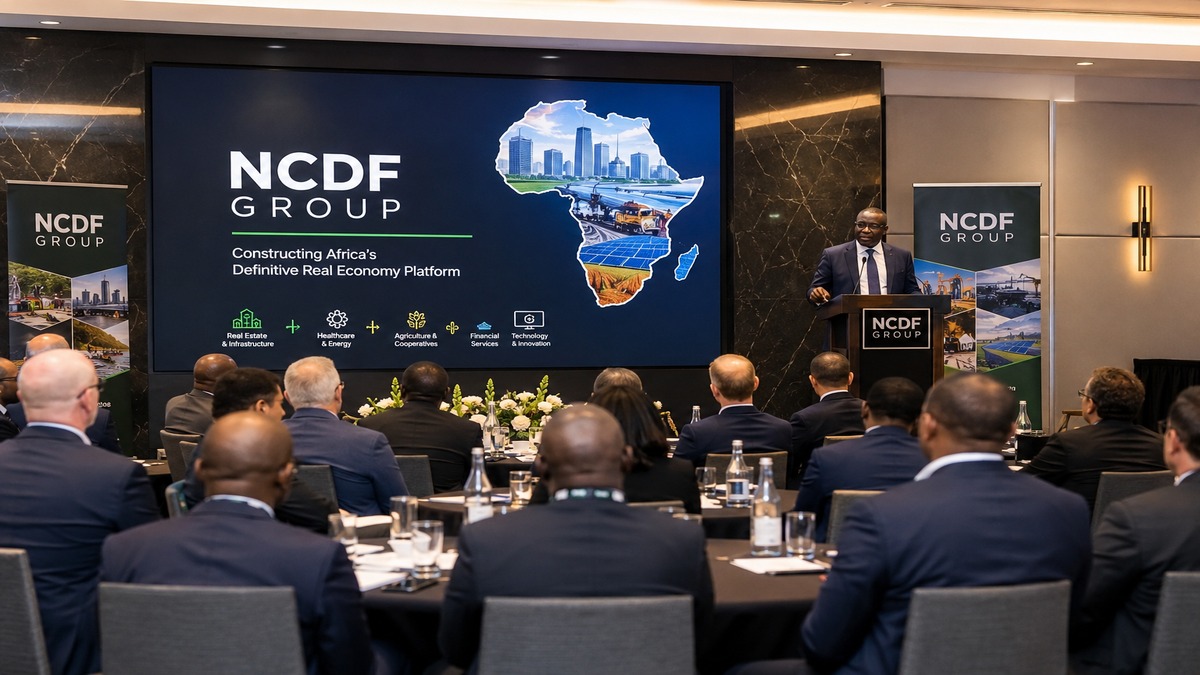
This is the space in which Nigerian Capital Development Fund, operating as NCDF Group, is positioning itself.
Under an ambitious institutional transformation and ecosystem consolidation programme, NCDF Group is building what may become one of Africa’s most comprehensive real-economy platforms: a structured operating ecosystem designed to connect international capital mobilisation, institutional-grade project structuring and direct local execution across multiple productive sectors.
The proposition is clear. Africa does not only need capital. Africa needs investable platforms capable of converting capital into bankable, governed and executed real assets.
The Real-Economy Gap
The African opportunity is often described in terms of demographics, technology adoption, natural resources and expanding consumer markets. These are valid indicators, but they do not automatically produce investable outcomes.
A market may have housing demand, but still lack bankable housing delivery vehicles. A country may have agricultural potential, but still struggle with fragmented producers and informal commodity flows. A health system may have urgent demand, but remain constrained by facility quality, financing gaps, power reliability and governance weaknesses. A city may need infrastructure, but lack execution platforms that can align land, capital, regulatory support and long-term management.
This is the gap between opportunity and institutional capital.
Global investors do not simply invest in need. They invest in structure. They require governance, documentation, risk allocation, execution capability, reporting discipline and credible routes to value creation. Where those elements are missing, capital either stays away, enters through short-term transactions, or concentrates in narrow sectors that are easier to understand but less transformational for the real economy.
NCDF Group’s strategy responds directly to this challenge.
Its emerging model is not that of a passive capital allocator. It is also not simply that of a project developer. It is designed as an integrated platform — one that connects capital formation, sector execution, local aggregation, digital coordination and institutional oversight.
The Architecture of a Continental Platform
A real-economy platform capable of moving serious development capital cannot operate as a loose collection of projects. It must have an architecture.
NCDF Group’s ecosystem is built around a central institutional logic: strategic oversight at group level, financial architecture through specialised capital and investment entities, and direct execution through sector-specific platform companies.
At the centre sits NCDF Holdings Limited as the group-level institutional and strategic oversight vehicle. Around it are financial and execution capabilities designed to support both capital mobilisation and asset delivery.
The financial architecture includes investment management, securities, commercial coordination, diaspora capital mobilisation and private-capital engagement routes. These functions are intended to create structured pathways through which capital can be prepared, mobilised, allocated and monitored.
The productive asset layer is where the group’s real-economy ambition becomes visible. It includes Fatherland Smart Cities for housing and urban development, LifeCome Healthcare and Health Energy for health infrastructure, LifeCome HMO for managed care and health financing, AfriGo Digital Economic Zone for agro-industrial trade and export-linked production, NCDFCOOP and CoopX for cooperative aggregation, and related digital and commercial infrastructure.
This is the strategic distinction.
NCDF Group is not building a single-sector company. It is building a platform of platforms across the physical and productive economy.
Capital Mobilisation: From Liquidity to Structured Participation
One of the most important dimensions of the NCDF model is its attempt to convert fragmented capital interest into structured participation.
In many African markets, capital mobilisation often suffers from two weaknesses. First, potential investors do not always see clearly structured vehicles with sufficient governance and reporting discipline. Second, local projects are frequently presented as isolated opportunities rather than as part of a wider execution ecosystem.
NCDF Group’s financial architecture seeks to solve this by creating institutional pathways for private capital, diaspora capital and development-aligned finance to engage with verified real-economy assets.
Diaspora capital is central to this thesis.
For decades, African diaspora inflows have played a stabilising role through remittances. But much of that capital remains consumption-linked, family-support oriented or informally deployed. NCDF Group’s opportunity is to reposition diaspora participation from informal remittance support into structured, asset-backed development participation.
That requires more than patriotic messaging. It requires credible vehicles, transparent governance, clear use-of-proceeds, measurable projects and disciplined reporting.
If properly executed, diaspora capital can become one of the most patient and mission-aligned sources of growth capital for African infrastructure, housing, enterprise and social development. NCDF Group’s platform offers a route for that capital to move from sentiment into structured economic participation.
Productive Asset Execution: Where the Platform Becomes Real
Capital is only as effective as the vehicle that receives it. This is where NCDF Group’s productive asset layer becomes strategically important.
Through Fatherland Smart Cities, the group is advancing a housing and urban development platform intended to support affordable housing, diaspora housing, mixed-use communities and public-private partnership-led delivery. Africa’s housing challenge is not merely about building units. It is about land security, infrastructure, finance, execution, documentation and community value. A platform approach can help reduce the risks that often weaken isolated housing projects.
Through LifeCome Healthcare and Health Energy, NCDF Group is positioning healthcare as infrastructure. The model connects hospitals, health financing, digital health intelligence and reliable energy. This matters because healthcare systems fail when facilities, funding, power and data are treated separately. By linking these elements, LifeCome can support a more integrated health infrastructure proposition.
Through AfriGo Digital Economic Zone and related agro-industrial initiatives, the group is engaging with one of Africa’s most important development frontiers: the formalisation of agro-industrial production, digital trade coordination, export readiness and commodity value-chain infrastructure. Africa’s agricultural economy is large, but its value is often trapped in informal aggregation, weak processing capacity and poor documentation. Digital and physical trade infrastructure can help move the sector from fragmented activity to organised production.
Through NCDFCOOP and CoopX, the group is addressing the cooperative economy — one of the most important but under-structured layers of African enterprise. Cooperatives are embedded in agriculture, savings, trade, housing, community finance and local production. Yet many remain disconnected from formal capital, buyers, technology and institutional markets. By aggregating and digitising cooperative participation, NCDF Group can help convert distributed local enterprise into a more visible and investable economic network.
This combination of housing, health, energy, agriculture, cooperatives and digital trade is what gives the NCDF platform its real-economy character.
De-Risking the African Real Economy
For institutional investors, the African real economy has often carried a high perception of risk. Some of this is macroeconomic. Some is regulatory. Much of it is structural.
Projects may be under-documented. Governance may be unclear. Execution capacity may be thin. Reporting may be inconsistent. Local counterparties may lack institutional systems. Assets may not be packaged in a way that meets the expectations of serious capital.
NCDF Group’s transformation strategy is designed to address this problem through institutional governance.
The group’s operating model separates strategic stewardship from sector execution. Group-level oversight provides institutional direction, capital discipline, reporting expectations and governance frameworks. Platform companies provide sector-specific execution. This separation is important because a real-economy ecosystem can only scale when accountability is clear.
The group’s wider institutional scale-up also includes executive recruitment, structured subsidiary governance, compliance frameworks, board-level oversight, operational reporting and capital mobilisation discipline. These are not administrative details. They are the systems that determine whether real assets can become investable assets.
Institutional investors do not only assess the opportunity. They assess the operator.
If NCDF Group can maintain governance quality, financial transparency, project documentation and operational discipline, it will strengthen its credibility as a gateway into the African real economy.
Why the Platform Model Matters
The future of African development will not be determined by isolated projects alone. It will be determined by repeatable platforms.
A single hospital can improve health access in one location. A healthcare infrastructure platform can coordinate facilities, financing, energy and digital health systems across multiple locations.
A single housing estate can deliver units. A smart cities platform can connect land, capital, construction, diaspora buyers, infrastructure and long-term community value.
A single cooperative can support members. A cooperative network can aggregate thousands of producers, buyers and enterprises into a bankable market system.
A single investment product can raise funds. A capital platform can match investors to multiple verified execution pathways.
This is why NCDF Group’s model is significant. It is attempting to build the connective tissue between capital and execution.
That connective tissue is the missing layer in many African markets.
The Paradigm Shift
For too long, African investment narratives have been divided into two extremes: high-growth digital ventures on one side and government-led infrastructure on the other. The real economy sits between them. It is where people live, work, produce, trade, receive care, build homes, organise cooperatives and create durable wealth.
NCDF Group’s platform thesis is that Africa’s next phase of growth must be built through institutionalised real-economy platforms capable of absorbing capital, executing assets and scaling impact.
This is not a rejection of technology. It is a redefinition of technology’s role. Digital systems are most powerful when they help organise the physical economy: trade, healthcare, housing, finance, cooperatives, energy and infrastructure.
The future of African economic strength will not come from frictionless applications alone. It will come from the productive foundations those applications help coordinate.
A Permanent Gateway into African Real Assets
NCDF Group is positioning itself as a permanent institutional gateway into African real assets.
Its advantage lies in the integration of capital pathways, platform companies, sector execution, diaspora engagement and governance architecture. Its challenge will be execution discipline: proving that the model can deliver assets, report transparently, convert partnerships into capital, and scale across sectors without weakening institutional control.
If it succeeds, NCDF Group could help establish a new blueprint for African development platforms — one where capital mobilisation, project structuring and asset execution are no longer disconnected activities but parts of one coordinated ecosystem.
The real opportunity is not merely corporate growth. It is market formation.
By building across financial architecture and productive asset layers, NCDF Group is seeking to solve one of Africa’s most persistent structural problems: how to make the real economy visible, investable and scalable for long-term capital.
That is the significance of the NCDF story.
It is not simply constructing companies. It is constructing a platform through which Africa’s physical economy can be organised, financed and executed with institutional discipline.