Healthcare access begins with affordability.
In Nigeria, millions of people do not avoid healthcare because they do not value it. They avoid care because the cost is uncertain, immediate and often unaffordable. For many households, illness is not only a medical event; it is a financial shock. A sudden hospital bill can disrupt savings, delay treatment, force informal borrowing or push families into difficult choices between health and livelihood.
This is the problem LifeCome HMO is designed to address.
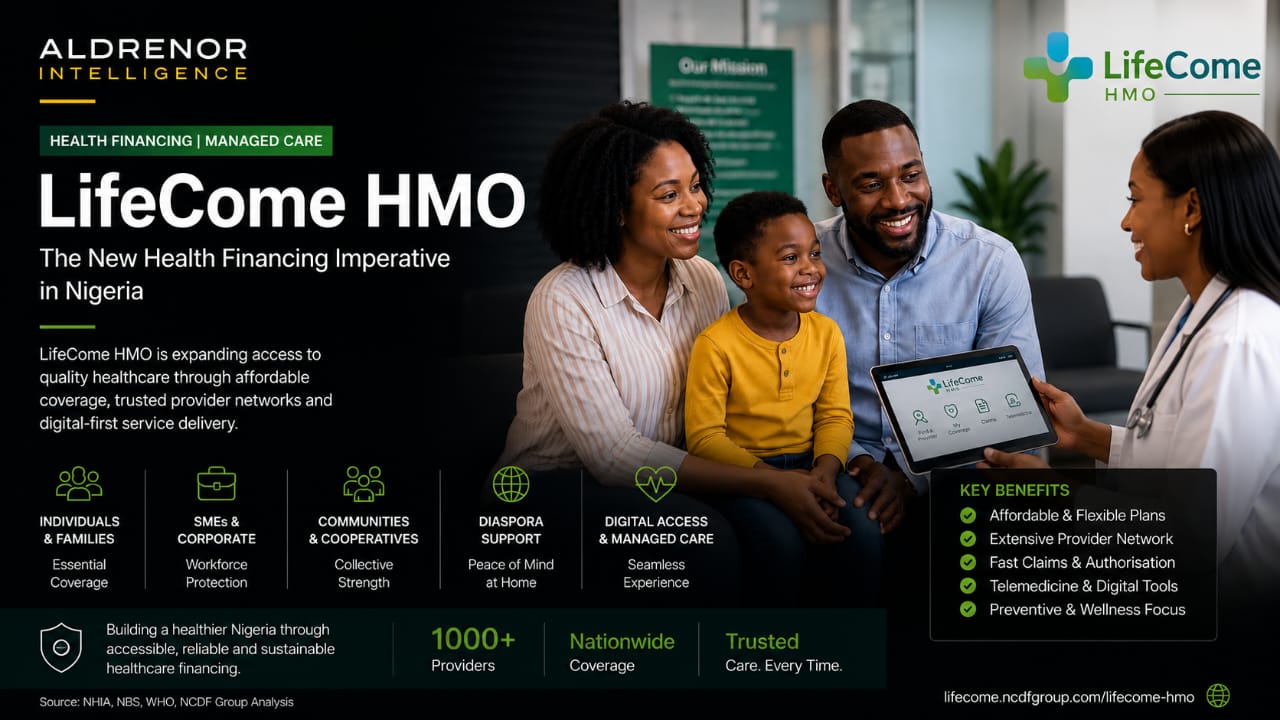
LifeCome HMO is positioned as a health financing and managed care platform within the broader LifeCome Healthcare & Health Energy system. Its role is to reduce out-of-pocket healthcare costs, improve access to quality care and connect individuals, families, employers, communities and institutions to a structured provider network.
The strategic importance of LifeCome HMO is best understood within Nigeria’s changing health financing environment.
The National Health Insurance Authority Act has strengthened the policy direction toward broader health insurance participation and universal health coverage. But legislation alone does not create access. For coverage to become meaningful, health insurance must be affordable, trusted, digitally accessible, provider-linked and operationally reliable.
That is where managed care platforms become important.
From Insurance Product to Healthcare Access System
The Nigerian health insurance market has historically faced a practical challenge: many products exist, but access remains uneven. A plan may be sold, but the user experience may be weak. A provider network may exist, but quality and availability may vary. A member may be enrolled, but claims processing may be slow. Employers may want employee health coverage, but need predictable pricing and reliable service.
LifeCome HMO’s proposition is to move health insurance beyond policy paperwork into coordinated care access.
The platform combines insurance products, provider network management, claims administration, digital systems and managed care protocols. This matters because health financing is not only about collecting premiums. It is about ensuring that coverage translates into real access when people need care.
A member should be able to enrol, understand the plan, identify approved providers, access services, track claims and receive support without navigating a confusing system. A provider should be able to deliver care within a structured payment and authorisation framework. An employer should be able to offer staff coverage with confidence. A community group should be able to organise collective participation. A diaspora family member should be able to support relatives at home through a credible healthcare pathway.
LifeCome HMO is designed to serve each of these use cases.
A Modular Coverage Architecture
One of the strongest features of the LifeCome HMO model is its modular coverage structure.
The platform is designed for individuals who need essential healthcare access, families seeking household protection, SMEs and corporate employers providing staff benefits, cooperatives and associations organising community participation, and diaspora Nigerians supporting family members at home.
This is commercially and developmentally important.
Nigeria’s health financing needs are diverse. A single product cannot serve all segments. Urban professionals, informal workers, small business owners, school communities, cooperative societies, religious associations, public-sector workers and diaspora families all have different affordability profiles, service expectations and risk patterns.
A modular structure allows LifeCome HMO to design coverage around real market behaviour.
Individual plans can serve young professionals, self-employed workers and people outside formal employment benefits. Family plans can support household-level care continuity. SME and corporate plans can help businesses reduce productivity losses associated with poor employee health. Community-based plans can extend coverage into cooperatives, associations and underserved populations. Diaspora-supported plans can convert emotional family support into structured healthcare protection.
This last category is particularly significant. Diaspora remittances often support medical emergencies after they occur. A diaspora health plan changes the timing and structure of support. Instead of waiting for a crisis, diaspora participants can help relatives access preventive, primary and managed care through a formal system.
The Provider Network Question
Health insurance is only as credible as the provider network behind it.
LifeCome HMO’s integration with the wider LifeCome platform gives it a strategic advantage. Because LifeCome is also connected to hospital operations, health energy and digital intelligence, the HMO can be positioned not as an isolated payer, but as part of a healthcare delivery ecosystem.
This integration matters for quality, utilisation and trust.
Members want assurance that coverage will result in care. Providers want assurance that claims and authorisations will be managed professionally. Investors and institutional partners want assurance that the model is scalable and auditable. Regulators want assurance that members are protected.
A strong provider network gives health insurance practical meaning.
LifeCome HMO’s network model includes hospitals, clinics, diagnostic centres and pharmacies. Through digital systems, the platform can support provider information, enrolment, claims tracking, member notifications and telemedicine access. These features are not cosmetic. They are essential to user confidence and operational efficiency.
Managed Care as Cost Discipline
In many markets, health insurance becomes unsustainable when utilisation, claims, provider pricing and patient pathways are poorly managed. Managed care exists to solve this problem.
LifeCome HMO’s managed care approach emphasises coordination, efficiency and quality. It works by connecting patient access with provider oversight, claims management, service utilisation monitoring and cost control.
The objective should not be to deny care. The objective should be to ensure that the right care is delivered at the right level, at the right time, through the right provider, with the right documentation.
This is critical in Nigeria’s healthcare market, where fragmentation can produce both under-treatment and inefficient spending. Some patients delay care until conditions become severe. Others move between providers without continuity. Providers may lack predictable payment systems. Employers may struggle to evaluate health benefit value.
Managed care can improve this structure by organising patient pathways and provider relationships.
Why LifeCome HMO Matters for NCDF Group
Within the NCDF Group ecosystem, LifeCome HMO plays a strategic role beyond insurance.
It supports healthcare affordability. It strengthens patient flows into healthcare facilities. It can help stabilise revenue for providers. It can support employer productivity. It can create structured participation pathways for cooperatives and communities. It can connect diaspora support with real healthcare access. It can generate data that improves planning across the LifeCome platform.
In institutional terms, LifeCome HMO is the financing layer of the healthcare system.
Hospitals provide capacity. Energy supports reliability. Digital intelligence supports coordination. The HMO enables access.
This is why the platform should be understood as part of a wider healthcare infrastructure model rather than a standalone insurance company.
The Future of Health Financing
Nigeria’s health financing future will depend on execution. Policy direction is moving toward broader insurance coverage, but implementation requires trusted institutions, credible provider networks, affordable products, transparent claims systems and user-friendly digital interfaces.
LifeCome HMO is entering the market at a moment when these capabilities are increasingly necessary.
For individuals, it offers a route away from unpredictable out-of-pocket spending.
For families, it offers structured protection.
For employers, it offers workforce health support.
For communities, it offers collective access.
For diaspora participants, it offers a credible way to support loved ones.
For providers, it offers a more organised payment and utilisation pathway.
For NCDF Group, it strengthens the healthcare platform’s commercial and social impact logic.
The deeper story is that health insurance in Nigeria must now become more than enrolment. It must become access, coordination, protection and trust.
LifeCome HMO’s opportunity is to help make that transition real.