Healthcare transformation in Nigeria cannot be solved by a single facility, a single insurance product, a single technology application or a single government intervention. The central challenge is systemic. Healthcare delivery depends on infrastructure, financing, clinical capacity, reliable energy, operational governance, digital coordination and patient trust working together.
This is the strategic logic behind LifeCome Healthcare & Health Energy.
Positioned within the NCDF Group ecosystem, LifeCome is being developed not merely as a healthcare brand, but as an integrated healthcare infrastructure and services platform. Its model brings together healthcare delivery, managed care, renewable energy support and digital health intelligence into a coordinated operating architecture.
That matters because Nigeria’s healthcare market is not short of demand. What it lacks is reliable delivery structure.
Across the country, households continue to face the pressure of healthcare costs, uneven access to quality care, power supply disruption, limited diagnostics and inconsistent facility standards. In many communities, healthcare is available in theory but unreliable in practice. A clinic may exist, but lack equipment. A hospital may have doctors, but struggle with power supply. A patient may need care, but lack insurance coverage. A government may own facilities, but lack the operational capital and management systems required to deliver consistent service quality.
LifeCome’s platform approach recognises that healthcare systems fail when their core components are treated separately.
From Health Facility to Health System
The conventional approach to healthcare development often begins with physical facilities. Build a hospital. Equip a clinic. Recruit professionals. Launch services.
These steps are necessary, but they are no longer sufficient.
A functioning healthcare system requires a wider operating model. Facilities must be maintained. Patients must be able to afford care. Providers must receive predictable payments. Equipment must be powered. Clinical decisions must be supported by data. Administrators must track performance. Government partners must see measurable public value.
LifeCome’s architecture is designed around this wider reality.
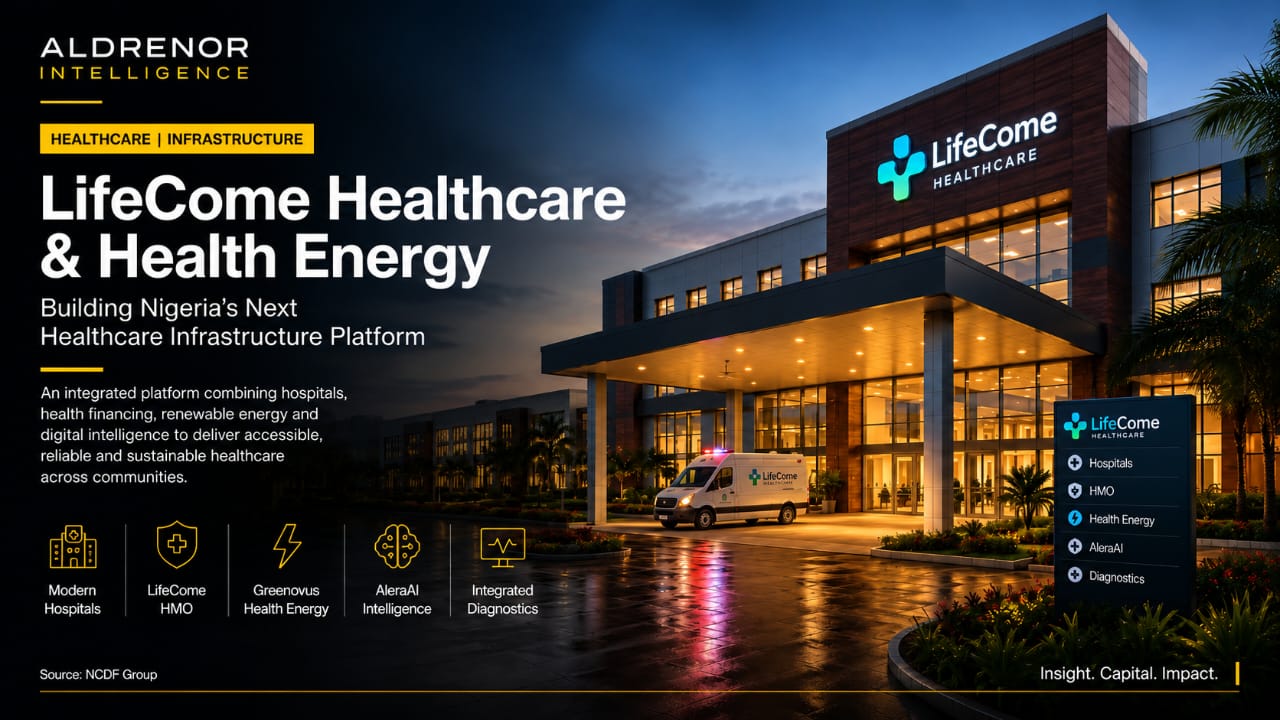
The platform is built around four complementary pillars: LifeCome Hospitals, LifeCome HMO, Greenovus Health Energy and LifeCome AleraAI. Together, these components create a more complete pathway for healthcare transformation.
LifeCome Hospitals focuses on the rehabilitation, modernisation and operation of healthcare facilities. This addresses the physical and clinical delivery side of the system.
LifeCome HMO provides the health financing layer, expanding access through structured coverage for individuals, families, employers, communities and diaspora-supported beneficiaries.
Greenovus Health Energy addresses one of the most under-discussed barriers in healthcare delivery: reliable power. Hospitals and health centres cannot operate efficiently where power is unstable. Diagnostics, emergency response, cold-chain systems, maternity services, surgical readiness and patient monitoring all depend on energy reliability.
LifeCome AleraAI introduces the digital intelligence layer, supporting feasibility, service coordination, continuity planning and data-led decision-making.
Individually, each component is useful. Together, they become infrastructure.
Healthcare as an Investable Development Platform
For investors, public-sector partners and development institutions, the significance of LifeCome lies in its platform structure.
Healthcare investment in emerging markets often faces a core challenge: fragmented revenue and fragmented execution. A hospital without insured patients can struggle with utilisation and affordability. An HMO without reliable provider capacity can struggle with service quality. A digital health product without physical delivery infrastructure can struggle to translate technology into patient outcomes. A renewable energy solution without a facility network can remain a standalone project.
LifeCome’s model seeks to reduce this fragmentation by connecting the components.
This creates the basis for multiple value streams: healthcare service delivery, managed care participation, energy-as-a-service for health facilities, digital coordination tools, PPP-based facility operations and institutional partnerships. The platform therefore becomes more than a healthcare operator. It becomes a healthcare infrastructure vehicle.
That distinction is important.
Infrastructure is not defined only by roads, bridges, power plants or ports. Social infrastructure — hospitals, health systems, insurance mechanisms, diagnostic capacity and digital coordination tools — is increasingly central to national productivity, community resilience and long-term economic development.
When citizens cannot access timely care, productivity declines. When households are exposed to catastrophic health spending, poverty deepens. When public facilities underperform, trust erodes. When healthcare systems lack reliable power, service continuity collapses.
LifeCome’s thesis is that healthcare must be treated as a structured development asset.
Public-Private Partnership Potential
Nigeria’s public healthcare system contains significant physical assets, but many require modernisation, operating discipline, technology and private-sector execution support. LifeCome’s platform model is well suited to public-private partnership structures because it does not require government to abandon ownership or policy responsibility. Instead, it allows government assets and public priorities to be supported by private capital, operational expertise and accountable service delivery frameworks.
This is particularly relevant for general hospitals, primary healthcare networks and state-level health infrastructure programmes.
Under a properly governed PPP model, public authorities can retain strategic oversight while private operators support modernisation, staffing systems, energy reliability, digital processes, claims coordination, facility management and service performance reporting.
For communities, the outcome should be better access. For governments, it should be improved facility performance. For investors, it should be a more structured route into healthcare infrastructure. For providers, it should mean more stable operating systems and predictable patient flows.
The Role of Health Energy
One of LifeCome’s most strategically important features is the inclusion of health energy within the platform.
Healthcare infrastructure cannot be resilient without energy resilience. A hospital that depends on unstable electricity supply must rely on expensive diesel generation, reduce operating hours or compromise service continuity. These weaknesses affect diagnostics, emergency care, maternal health, surgery, laboratory services, vaccine storage and patient safety.
By integrating renewable and hybrid energy solutions into the healthcare platform, LifeCome addresses a foundational constraint. Greenovus Health Energy can become an enabling layer for hospital reliability, cost management and climate-aligned infrastructure.
This is not merely an environmental proposition. It is an operational proposition.
In healthcare, power reliability is care reliability.
The Digital Intelligence Layer
LifeCome AleraAI gives the platform an additional strategic dimension. As healthcare systems scale, the challenge is not only to deliver services but to understand where services are feasible, what resources are required, how patient pathways should be coordinated and how operational risks should be managed.
Digital intelligence can support facility planning, demand mapping, service readiness, care continuity, provider coordination and performance oversight. In an environment where data gaps often weaken health planning, an AI-supported operating intelligence layer could become a critical institutional tool.
The opportunity is not to replace healthcare professionals. It is to support them with better information, better workflows and better planning systems.
The Strategic Meaning of LifeCome
LifeCome Healthcare & Health Energy represents an important institutional shift. It reframes healthcare from charitable intervention or isolated service delivery into an integrated development platform.
Its strategic value lies in the combination of four propositions.
First, it strengthens access through healthcare delivery capacity.
Second, it improves affordability through health financing.
Third, it supports reliability through health energy.
Fourth, it enables scalability through digital intelligence.
For Nigeria, this model speaks directly to the future of healthcare transformation. The country needs more than hospitals. It needs healthcare systems that can be financed, powered, operated, monitored and scaled.
For NCDF Group, LifeCome provides a sector platform through which capital, infrastructure, technology and public value can meet.
For Aldrenor’s readers, the lesson is broader: the next generation of African healthcare platforms will not be judged only by the number of facilities they build, but by the quality of systems they create.
LifeCome’s proposition is that healthcare becomes stronger when infrastructure, financing, energy and intelligence are designed to work together.